Your Notifications
All done, no notifications

ESWL Cost in Monastir

Costs starts from USD1500 to USD3000
Filters

Need Help Planning Your Treatment Abroad?

Your 24/7 AI Health Assistant

Extracorporeal shock wave lithotripsy (ESWL) is a procedure that involves breaking up stones in the urinary tract, bile ducts, or pancreatic ducts by using shock waves generated by a lithotripter.

The shock waves enter the body and are accurately targeted using X-ray imaging. The procedure aims to break the stones into smaller pieces that can either pass naturally through the body or be more easily collected.

For stones in the kidneys and ureter, the fragments will be expelled with urine. For Larger stones in the bile ducts or pancreatic duct, they are removed using an endoscope—a flexible tube inserted through the mouth.

Classification

The following are the main classifications:

Based on the Shock Wave Generator Type

  • Electrohydraulic Lithotripters: They use underwater sparks to generate shock waves.
  • Electromagnetic Lithotripters: They use electromagnetic coils to produce shock waves.
  • Piezoelectric Lithotripters: They employ piezoelectric crystals that expand and contract to produce shock waves.

Based on the Targeting Method

  • Fluoroscopy-Guided ESWL: Uses X-ray imaging to locate and target the stone.
  • Ultrasound-Guided ESWL: It uses ultrasound imaging to locate and target the stone.

Based on Stone's Characteristics

  • Size of Stone
  • Composition of Stone
  • Calcium-based stones

Based on the Location of Stone

  • Kidney stones: Typically easier to treat with ESWL.
  • Ureteral stones: May require different positioning or additional treatments.

The purpose of ESWL is to destroy kidney or ureteral stones using shock waves and fragment them into smaller pieces that can pass more easily through the urinary tract. It is a non-surgical alternative to removal that can relieve pain, prevent infection, and restore normal urine flow.

If you experience symptoms such as a bad case of flank pain, hematuria, recurrent UTIs, vomiting or nausea, or difficulty urinating, you need to consult a doctor. These may be ureteric or kidney stone symptoms.

Blood and urine analyses, imaging studies, and checking current prescriptions are a few examples of preparation. In addition to possibly having to discontinue the use of blood thinners or other medications that inhibit clotting, patients are often asked to fast for several hours before the surgery.

  • Sedation or Anaesthesia: Based on the patient's status and expected pain, mild sedation or light anaesthesia may be employed to reduce discomfort during surgery.
  • Application of Shock Waves: The stone is the very specific target of high-energy shock waves generated from outside. These waves fragment the stone into smaller pieces as they travel through the soft tissues.
  • Monitoring and Adjustment: Imaging is employed to monitor the process continuously. To ensure accurate targeting, shock wave position or intensity may be altered.
  • Recovery and Completion: After treatment is completed, which typically takes 30 to 60 minutes, the patient is monitored for a brief period and then discharged.

ESWL typically lasts about an hour. However, depending on the number and size of your kidney stones and overall health, your treatment could take longer or less time.

  • Obstruction of your ureter
  • Bleeding
  • Infection

ESWL can allow you to pass kidney stones by yourself without requiring more invasive surgery to have them removed.

Patients can take pain medication and fluids in larger quantities to help pass fragments. Straining urine may be advised to collect stone fragments for analysis. To confirm the stone has been removed, follow-up imaging can be scheduled.

The size, composition, and location of the stone all influence success. The clearance rate for stones under 2 cm is 70–90%. Larger or more complex stones require more than one session.

Would you like some help? We are available.

Get Help
Explore Hospitals ( 1 )
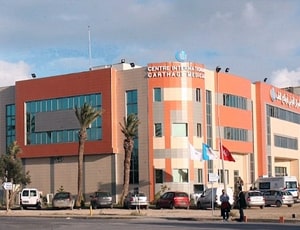
ESWL in Carthage International Medical Center: Costs, Top Doctors, and Reviews

Monastir, Tunisia

  • Joint Commission International, or JCI

Apart from in-detail treatment procedures available, Carthage International Medical Center located in Monastir, Tunisia has a wide variety of facilities available for International Patients. Some of the facilities which are provided by them are Accommodation, Airport Transfer, Choice of Meals, Interpreter, SIM, TV inside room. Also listed below are some of the most prominent infrastructural details:

  • The Hospital covers an area of about 15,000 sqm with a capacity of about 133 beds
  • Standard Rooms & Suites facility is available in order to give them physical and psychological comfort to the patients
  • Furthermore, the rooms are equipped with plasterboard partitions for optimum sound and thermal comfort, individual bathrooms, a television with satellite reception, and a fire door, etc.
  • Ambulance of the Hospital is fully equipped with all the necessary medical equipment of latest technology ensuring the best medical transportation services of the patients
  • The hospital has a Department for international patients offering interpreter services for various languages

Need Some Advice From Our Experts?

Request a Call Back Now!

Our team of healthcare experts would be happy to assist you

trusted Patientstrusted Patients+99
Trusted by 50000+ Patients
Required | alphabets and spaces
Required | A valid, working email address
Required | A valid contact

Process Involved for ESWL in Monastir

  • Consultation: See a urologist to check the kidney stone's size, location, and nature.
  • Pre-operative evaluation: Evaluate medical history and conduct imaging studies to verify the stone's nature.
  • Discussion of Treatment: Consider whether or not ESWL (Extracorporeal Shock Wave Lithotripsy) is appropriate or whether other treatment will be required.
  • Treatment Procedure: Discover the process of ESWL, pain to be anticipated, and experience to be looked for.
  • Post-Treatment Follow-up: Observe for stone fragments, control pain, and see no complications develop.
  • Kidney Stones
  • Ureteral Stones
  • Urinary obstruction, pain, or hematuria are the signs of ureteric or kidney stones.
  • The stones are also too large to pass through individually.
  • Medication and other non-surgical treatments have failed.
  • Stones are verified by imaging (CT scan, ultrasound, or X-ray).
  • Non-invasive: No cuts are needed.
  • Reduces the necessity of general anesthesia and hospital stay.
  • High success rate in breaking down stones into smaller fragments.
  • Shorter recovery time compared to surgery.
  • Urologist
  • Fill out the inquiry form: Fill out the form to provide us with the relevant information about your condition.
  • Consult with Our Healthcare Expert: One of our qualified specialists will contact you for a consultation.
  • Receive a Detailed Treatment Plan: After examining your situation, we will provide you with a detailed treatment plan that includes expert views and cost breakdowns for various choices.
  • Choose your preferred option: Choose the treatment option that suits you the best.

Instantly Connect with our ESWL Specialists

Doctor 1
Doctor 2
Doctor 3
Doctor 4
Doctor 5
Doctor 6
Doctor 7
Doctor 8
Our Services to Better your Experience

Opinion & Option

We submit the most accurate opinion and options from one or more countries for your review

Consult Privately

Consult with a certified specialist privately on our telemedicine platform even before you decide to travel

Logistics

We handle flights, visas, transfers, and accommodation—so you can focus on your health.

Recovery

Our In-house rehabilitation service packages to better your recovery and treatment outcome

Other Popular Countries for ESWL

Our network connects you with the leading medical tourism destinations globally, offering a wide range of cities, top doctors, and flexible pricing options.

Turkey
Malaysia
United Kingdom
United Arab Emirates

Frequently Asked Questions

ESWL package cost in Monastir has different inclusions and exclusions. Some of the best hospitals for ESWL offer a comprehensive package that covers the end-to-end expenses related to investigations and treatment of the patient. The ESWL package in Monastir includes the fees of the surgeon, hospitalization and anesthesia as well. A prolonged hospital stay due to delayed recovery, new diagnosis and complications after surgery may increase the cost of ESWL in Monastir.

There are many hospitals across the country that offer ESWL to international patients. Some of the best hospitals for ESWL in Monastirinclude the following:

While the speed of recovery may vary from patient to patient, they are still required to stay for about 12 days after discharge. This is important to ensure that the surgery was successful. During this time, control and follow-up tests take place to check for medical fitness.

Monastir is considered to be one of the best places for ESWL in the world. This is because of the availability of some of the best doctors, advanced medical technology and good hospital infrastructure. Some of the other top destinations for ESWL include the following:

Apart from the cost of ESWL, the patient is also required to pay additionally for daily meals and guest house accommodation. These charges may vary from 35 USD per person.

After the ESWL surgery takes place, the average duration of stay at the hospital is about 2 Days. This phase is important to ensure that the patient is recovering well and is clinically stable. During this time, several tests are performed before the patient is deemed suitable for discharge.

Out of all the hospitals in Monastir, there are about 1 Hospitals best hospitals for ESWL in Monastir. These hospitals have the required expertise as well as infrastructure available to handly patients who need ESWL. Additionally, these hospitals are known to comply with the international standards as well as local legal requirements for the treatment of patients.

Author

Dr. Vishwas Kaushik

MBBS, MD

5 Years of Experience

Dr. Vishwas Kaushik is a qualified medical professional holding an MBBS from the prestigious Belgorod State University, Russia, with a strong foundation in clinical medicine and healthcare practice. His comprehensive medical training has equipped him with a profound understanding of evidence-based clinical practices, patient-centered care, and the evolving landscape of modern medicine. With a keen interest in medical research and scientific communication, he consistently translates complex clinical concepts into clear, accurate, and accessible content for diverse audiences. His work reflects a deep commitment to advancing medical knowledge, delivering impactful healthcare insights, and bridging the gap between clinical expertise and accessible medical communication.. View More