Your Notifications
All done, no notifications

Esophagectomy Cost in Noida

Costs starts from USD4500 to USD9500
Filters

Cost of Esophagectomy in Major cities of India

CityMinimum Cost (USD)Minimum Cost (INR)Maximum Cost (USD)Maximum Cost (INR)
AhmedabadUSD 4050377541USD 8550797031
BangaloreUSD 4500419490USD 9500885590
ChennaiUSD 4500419490USD 9500885590
DelhiUSD 4500419490USD 9500885590
FaridabadUSD 4500419490USD 9500885590
GhaziabadUSD 4500419490USD 9500885590
GurgaonUSD 4500419490USD 9500885590
GurugramUSD 4500419490USD 9500885590
HyderabadUSD 4500419490USD 9500885590
KochiUSD 4500419490USD 9500885590
KolkataUSD 4500419490USD 9500885590
MohaliUSD 4050377541USD 8550797031
MumbaiUSD 4500419490USD 9500885590
NoidaUSD 4500419490USD 9500885590
PuneUSD 4050377541USD 8550797031

Need Help Planning Your Treatment Abroad?

Your 24/7 AI Health Assistant

Esophagectomy is a major surgery that removes a portion or all of the oesophagus, typically for oesophageal cancer or cancer of the gastro-oesophageal junction (GEJ). Additionally, it might be advised in some non-cancer disorders including advanced Barrett's oesophagus with high-grade dysplasia, infrequently for non-malignant strictures, or in emergency scenarios like severe esophageal damage or perforation.

Consult a professional if you have progressive difficulty swallowing (dysphagia), particularly with solid foods, unexplained weight loss, chronic reflux/heartburn that is not eased by medication, regurgitation or vomiting, or chest pain/discomfort while swallowing. Additionally, if you get prolonged hoarseness, a chronic cough, blood in your vomit, or black stools, you should get medical help.

Esophagectomy preparation consists of a complete medical fitness assessment, endoscopy with biopsy, CT/PET-CT staging, and, in some cases, EUS, as well as heart testing (ECG/echo), lung function tests (PFT), and blood tests for liver and kidney function.

Esophagectomy is a general anaesthetic procedure that involves removing the diseased section of the oesophagus, as well as any adjacent lymph nodes. The digestive tract is then rebuilt by making a new link (anastomosis) with the residual oesophagus, typically with a stomach pull-up (and in certain circumstances, colon interposition). A feeding tube (jejunostomy) may be inserted to provide nourishment during recovery, and it may be carried out via minimally invasive thoracoscopic/laparoscopic, abdominal–chest, or abdominal–neck techniques.

Depending on the surgical technique (open vs. minimally invasive), the intricacy of the condition, and whether reconstruction is necessary, an esophagectomy typically takes four to eight hours.

A major surgical procedure is an esophagectomy. Among the potential issues are:
  • Bleeding
  • Infection (pneumonia, chest wound infection)
  • Anastomotic leak (surgical connection leak)
  • Breathing difficulties brought on by lung involvement
  • Damage to the vocal cord nerve (hoarseness)
  • Clots of blood (DVT/PE)
  • Narrowing at the anastomosis, or stricture
  • Acid reflux and problems swallowing
  • Delayed emptying of the stomach
  • Chronic nutritional deficiencies

Esophagectomy has several significant advantages, including being a curative therapeutic option for resectable esophageal cancer, removing diseased tissue and thereby lowering the chance of cancer spread, and facilitating swallowing and food transit. It can improve general quality of life after recovery and boost long-term survival in appropriate cancer situations.

Depending on the patient's health, recovery usually entails ICU monitoring for one to three days, followed by an overall hospital stay of seven to fourteen days (longer if complications occur). Pain management, chest physical therapy, and a stepwise eating schedule-beginning with tube feeding, moving on to liquids, soft foods, and finally normal intake-are all part of post-operative care.

The success of an esophagectomy is determined by factors such as cancer stage, the patient's lung function and overall health, hospital and surgeon experience, early diagnosis, and suitable treatment planning. Esophagectomy can offer excellent long-term survival benefits in early and locally advanced cases when paired with chemo-radiotherapy when necessary, particularly in highly specialised centres.

Would you like some help? We are available.

Get Help
Explore Hospitals ( 3 )
Esophagectomy in Metro Hospital: Costs, Top Doctors, and Reviews

Noida, India

  • National Accreditation Board for Testing and Calibration Laboratories (NABL)
  • National Accreditation Board for Hospitals & Healthcare Providers (NABH)

Metro Hospital located in Noida, India is accredited by ISO, NABH, NABL. Also listed below are some of the most prominent infrastructural details:

  • Metro Hospital is a 317 bedded state-of-the-art super speciality hospital, which is functioning as two units- 110 beds capacity in Metro Heart Institute and 207 beds capacity in Metro Multispeciality Hospital
  • 45 beds in Intensive Coronary Care and High Dependency Unit
  • 24/7 Blood Bank
  • 24/7 Pharmacy
  • 24/7 Cardiac Ambulance
  • 24/7 Emergency unit
  • Different types of patients in-patient rooms are available for patients convenience- Super Deluxe rooms (8), Deluxe Rooms (2), Private Rooms (6), Semi-private rooms (14), Triple bedded rooms (6), Four bedded rooms (8), Five bedded rooms (5) and Six bedded rooms (12)
  • Cafeteria/Restaurant
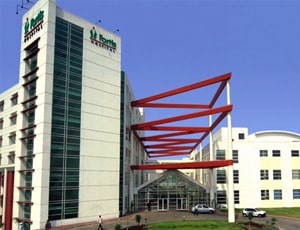
Esophagectomy in Fortis Hospital: Costs, Top Doctors, and Reviews

Noida, India

3.0 ( 1 Reviews )
  • National Accreditation Board for Hospitals & Healthcare Providers (NABH)
  • National Accreditation Board for Testing and Calibration Laboratories (NABL)

Fortis Healthcare Limited is one of India’s prominent providers of integrated healthcare services, offering comprehensive medical care across multiple specialities. The company’s operations span hospitals, diagnostic centres, and day-care speciality facilities, ensuring a wide range of healthcare solutions under one umbrella. Fortis has established a strong presence across the country, managing 33 healthcare facilities, which include joint ventures and operational & management (O&M) setups, across 11 states.

The company’s hospital network comprises more than 5,700 operational beds, including O&M beds, catering to patients with varied healthcare needs. In addition to inpatient services, Fortis operates around 400 diagnostic laboratories, providing reliable and timely diagnostic support for accurate medical care. This extensive network enables Fortis to deliver high-quality healthcare services consistently and efficiently, from routine diagnostics to specialised treatments and complex procedures.

Esophagectomy in Jaypee Hospital: Costs, Top Doctors, and Reviews

Noida, India

  • National Accreditation Board for Hospitals & Healthcare Providers (NABH)
  • Joint Commission International, or JCI

Jaypee Hospital located in Noida, India is accredited by ISO, NABH, NABL. Also listed below are some of the most prominent infrastructural details:

  • 525 beds in the first phase
  • 150 Critical Care beds
  • 325 ward beds with Suite, Deluxe, Twin Sharing, and Economy options
  • 18 Modular OTs
  • 4 Cardiac Catheterization Lab with unqie Hybrid Operating Room
  • 24 bedded Advanced Neonatal ICUs20 bedded Dialysis Units
  • 2 Linear Accelerator (IMRT, VMAT, I
  • GRT), Wide Bore CT Simulator, one Brachytherapy Suite
  • True Beam STx Linear Accelerator
  • 2 MRI (3.0 Tesla) with High-Intensity Focused Ultrasound
  • 64 Slice PET CT, Gamma Camera, Dual Head 6 Slice SPECT CT
  • 256 Slice CT Scan, CT Simulation
  • Amongst the few GOLD LEED-certified hospital buildings in India
  • Appointment Scheduling
  • Flow motion 64 Slice PET CT technology
  • Pick and drop facility from/to the Airport
  • Foreign exchange facility
  • Treatment packages
  • Visa assistance
  • Admission in the hospital
  • Wi-Fi/internet service in the room
  • Travel arrangement for patient & attendant after discharge
  • Tele-consults after discharge
  • Dedicated Guest House for International Patients maintained by Jaypee Hospital
  • In-house translators for patient’s comfort
  • Assistance in getting doctor’s opinion
  • Registration with the Foreigners Regional Registration Office
  • Accommodation arrangements after discharge
  • Accommodation arrangement for the accompanying attendant
  • Customized diet for patient and attendant
  • Laundry services
  • Prayer room
  • Dialysis facility for 60 patients
  • Cadaver organs
  • Blood bank facilities
  • Advanced Laboratory facilities
  • Diagnostic and Radiology facilities
  • High-end Ultrasound facilities

Need Some Advice From Our Experts?

Request a Call Back Now!

Our team of healthcare experts would be happy to assist you

trusted Patientstrusted Patients+99
Trusted by 50000+ Patients
Required | alphabets and spaces
Required | A valid, working email address
Required | A valid contact

Process Involved for Esophagectomy in Noida

  • Endoscopy, biopsy, CT/PET, and staging
  • Tumour board multidisciplinary evaluation
  • Optimising diet and pulmonary rehabilitation prior to surgery
  • Neoadjuvant radiation or chemotherapy, if applicable
  • Surgery for an esophagectomy
  • ICU and the healing process after surgery
  • Progression of the diet, rehabilitation, and monitoring
  • Depending on the pathology result, adjuvant therapy may be necessary.
  • Esophageal cancer (adenocarcinoma/squamous cell carcinoma)
  • Cancer of the gastro-oesophageal junction
  • Barrett's esophageal severe dysplasia (selected cases)
  • Rarely, complicated esophageal injuries or strictures

Esophagectomy types include:

  • Esophagectomy Transhiatal
  • Transthoracic Esophagectomy
  • Three-phase esophagectomy (McKeown)
  • Esophagectomy by Ivor Lewis
  • Esophagectomy with Minimal Invasion (MIE)
  • Esophagectomy with robotic assistance

A patient might be eligible for esophagectomy if:

  • Without distant metastases, cancer is localised and treatable.
  • Both general anaesthesia and major surgery are appropriate for this patient.
  • Sufficient lung and cardiac health
  • Nutritional status can aid in healing.
  • Biopsy and endoscopy
  • Placement of a feeding jejunostomy
  • Separation of lymph nodes
  • Chemotherapy/radiation
  • Stricture dilatation (if necessary later)
  • Provides the best probability of cure in resectable instances.
  • Enhances the ability to swallow following recuperation
  • Allows for precise lymph node evaluation staging.
  • Increases survival when paired with cancer treatment.

After esophageal surgery, patients can expect:

  • Progressive improvement in feeding and swallowing
  • Dietary adjustments are required (small, frequent meals)
  • Potential drugs for reflux management
  • Frequent monitoring for recurrence (if cancer-related)
  • Fill out the inquiry form: Fill out the form to provide us with the relevant information about your condition.
  • Consult with Our Healthcare Expert:One of our qualified specialists will contact you for a consultation
  • Receive a Detailed Treatment Plan:After examining your situation, we will provide you with a detailed treatment plan that includes expert views and cost breakdowns for various choices.
  • Choose your preferred option: Choose the treatment option that suits you the best.

Instantly Connect with our Esophagectomy Specialists

Doctor 1
Doctor 2
Doctor 3
Doctor 4
Doctor 5
Doctor 6
Doctor 7
Doctor 8
Our Services to Better your Experience

Opinion & Option

We submit the most accurate opinion and options from one or more countries for your review

Consult Privately

Consult with a certified specialist privately on our telemedicine platform even before you decide to travel

Logistics

We handle flights, visas, transfers, and accommodation—so you can focus on your health.

Recovery

Our In-house rehabilitation service packages to better your recovery and treatment outcome

Other Popular Countries for Esophagectomy

Our network connects you with the leading medical tourism destinations globally, offering a wide range of cities, top doctors, and flexible pricing options.

Turkey
Vietnam
Malaysia
Spain

Frequently Asked Questions

Initial recovery takes 6-12 weeks, but full strength and nutritional recovery can take many months.However, complete recovery including nutritional stabilization and return to normal daily activities, may take several months. Recovery time can vary depending on the patient’s age, overall health, surgical approach used and presence of any post-operative complications.

In addition to the procedure cost, patients may incur:
  • Pre-treatment tests
  • Medications during recovery
  • Follow-up consultations
  • Depending on recovery and problems, a hospital stay typically lasts between 7 to 14 days. This includes time spent in the ICU for close monitoring followed by transfer to a regular ward.

    Long-term care includes of:
  • Dietary adjustments (little, frequent meals)
  • Reflux and strictures monitoring
  • Physiotherapy and breathing exercises
  • Supplemental nutrition if necessary
  • Frequent monitoring tests for cancer
  • India is chosen for its advanced cancer care infrastructure, availability of professional oncology teams and skilled thoracic surgeons, fairly priced surgery packages, quicker scheduling, and good international patient support services.

    PET-CT and CT scans, upper gastrointestinal endoscopy with biopsy, and blood tests like CBC, LFT, and RFT are important assays. ECG and echocardiogram, pulmonary function tests, and a nutritional assessment may also be necessary, depending on the patient's health.

    Yes. Esophagectomy is a safe procedure that is frequently carried out for patients from other countries in well-equipped institutions with skilled thoracic oncology teams.

    When carried out in specialised facilities, success rates are excellent. The primary determinants of long-term survival are cancer stage and responsiveness to further treatment.

    Author

    Fauzia Zeb Fatima

    M.Pharm

    4 Years of Experience

    Fauzia Zeb is a distinguished medical and scientific content writer with a robust academic foundation in pharmaceutical sciences, holding a B.Pharm and M.Pharm degree from prestigious institutions, including MIT and Jamia Hamdard University. Her comprehensive expertise in pharmacology, clinical sciences, and biomedical research enables her to translate complex medical and scientific concepts into precise, evidence-based content tailored for diverse audiences. Specializing in peer-reviewed articles, clinical blog posts, and research-driven publications, she demonstrates a consistent ability to bridge the gap between advanced medical science and accessible, audience-specific communication. . View More