Your Notifications
All done, no notifications

Portal Vein Embolization (PVE) Cost in Bangkok

Costs starts from USD5000 to USD10000
Filters

Cost of Portal Vein Embolization (PVE) in Major cities of Thailand

CityMinimum Cost (USD)Minimum Cost (THB)Maximum Cost (USD)Maximum Cost (THB)
BangkokUSD 5000163550USD 1635505349720

Need Help Planning Your Treatment Abroad?

Your 24/7 AI Health Assistant

Portal vein embolization (PVE) is done to increase the size and function of the healthy part of the liver (future liver remnant) before major liver surgery. It is an important preoperative technique for minimising postoperative liver failure.This process guarantees that, following resection, the remaining liver can fulfil the body's metabolic needs.

You should see a specialist if you have a liver tumour that needs to be surgically removed, if a big liver resection is planned but the remaining liver volume is likely to be minimal, or if you have a liver mass with abnormal liver function tests. If you experience symptoms like chronic right upper abdomen pain, jaundice, unexplained weight loss, exhaustion, or appetite loss, you should also seek medical assistance.

PVE preparation consists of contrast CT/MRI with liver volumetry, and blood tests (CBC, LFT, RFT, PT/INR, hepatitis markers, patients may need to grant permission for contrast and interventional radiology procedures, stop taking blood thinners or antiplatelets, and fast for six to eight hours.

Portal Vein Embolization is performed in an interventional radiology suite:
  • Both sedation and/or local anaesthesia are administered.
  • A little skin incision is done to gain access to the portal vein system.
  • Under imaging, a catheter is inserted into the branches that supply the area of the liver that needs to be removed.
  • These portal vein branches are blocked by injecting embolic materials.
  • Blood flow is diverted to the future liver remnant, which is the surviving liver.
  • The puncture site is sealed when the catheter is removed.
  • The patient's liver function, discomfort, and vital signs are tracked.

Depending on the anatomy and complexity of the liver, the treatment usually takes 60 to 120 minutes.Following the procedure, monitoring is done to make sure vital signs are stable and there are no problems right away.

PVE is generally safe but few possible complications may be arise:
  • Fever or pain following embolisation
  • Haematoma or bleeding at the puncture location
  • An infection
  • Contrast kidney strain or allergy (rare)
  • Portal vein thrombosis: an uncommon but dangerous condition
  • Malfunction of the liver, particularly in cirrhosis
  • Rare non-target embolisation
  • Nausea, fatigue and temporary loss of appetite

PVE has several benefits: increasing the amount of liver left over after surgery, reducing the risk of liver failure after hepatectomy, and raising the possibility that a major liver resection is safe are only a few advantages of PVE. It improves cancer patients' long-term surgery outcomes and is relatively less invasive than surgical alternatives.

After PVE, recovery typically happens quickly, with a hospital stay of one to three days and a few days of minor fever and gastrointestinal pain. Before undergoing final surgery, the majority of patients resume their regular activities in 5–10 days, and follow-up imaging in 2–6 weeks evaluates liver growth. Initially, heavy activity should be avoided and continuous monitoring should be maintained.

Effective liver enlargement can be achieved by portal vein embolisation; 70–90% of patients exhibit liver growth, and the majority of eligible patients develop sufficient hypertrophy to undergo scheduled liver surgery. The type and development rate of the tumour, the patient's functional and nutritional state, and liver health (healthy vs. cirrhotic) all influence overall success.

Would you like some help? We are available.

Get Help
Explore Hospitals ( 4 )
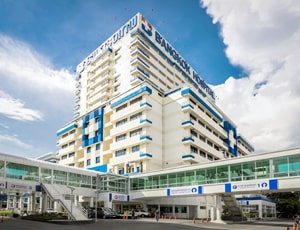
Portal Vein Embolization (PVE) in Bangkok Hospital: Costs, Top Doctors, and Reviews

Bangkok, Thailand

  • Joint Commission International, or JCI

Bangkok Hospital located in Bangkok, Thailand is accredited by JCI. Also listed below are some of the most prominent infrastructural details:

  • It is recognised for the application of the newest healthcare technology.
  • Blood analysis center that is not just the best in Thailand but in Asia Pacific as well.
  • Biomolecule center that is the seed of healthcare equipment for Thailand and overseas.
  • International affiliations and collaborations with universities and hospitals in Japan and the United States of America.
  • 11 hospitals are recognised as Centers of Excellence.
  • Known excellence in Trauma, Orthopedics, Cardiovascular, Neurology as well as Cancer Care.
  • There is a proper streamlined patient services process followed in Bangkok Dusit Medical Services, Bangkok, Thailand.
  • A well developed research center showcases the intent of the organisation to provide research based treatment opportunities to the patients.
  • The group has several Medical industry partnerships as well to ensure healthcare solutions.
Portal Vein Embolization (PVE) in Bangpakok 9 International Hospital: Costs, Top Doctors, and Reviews

Bangkok, Thailand

  • Joint Commission International, or JCI

Bangpakok 9 International Hospital located in Bangkok, Thailand is accredited by JCI. Also listed below are some of the most prominent infrastructural details:

  • It would be prudent to summarise the Medical Services provided at the Bangpakok 9 International Hospital (BPK 9), Bangkok, Thailand:
  • Cosmetic Dentistry
  • Dental Implants
  • Electrocardiogram (EKG or ECG)
  • Exercise Stress Test
  • Health Screening
  • Laser Vagina Firming
  • Pediatric Physical Therapy
  • Perfect Slim by Vela II
  • Physical Therapy for Musculoskeletal
  • Prosthodontics
  • The Medical Services are also inclusive of the International Patient Services such as the ones listed here:
  • Thai, English, French, Arabic, Chinese, Myanmar, Cambodia, Bangladeshi, Bahasa and Tagalog are the languages in which there are Translation services available for International Patients.
  • Visa extension related assistance
  • International health insurance related assistance
  • Embassy and international organizations related assistance
  • A variety of meals of choice for International Patients
  • Email consultation services
  • Transfer to either airport and/or hotels
  • Prayer room
  • Four different types of rooms are available such as Deluxe room, two kinds of suites, and a VIP suite.
  • Hospital facilities like The Coffee shop, Food Hall, Cafe and Medical Spa.
  • Complete health and safety protocols are maintained in the various Medical Centers some of whom are as follows:
  • Aesthetic Center
  • 24 Hour Emergency Center
  • Allergy Center
  • Breast Center
  • bSmart Center
  • Checkup Center
  • Dental Center,
  • Happy Long Life Center
  • Medical Fitness Center
  • Psychiatric Center
  • Rehabilitation Center
  • Sleep Disorders Center
Portal Vein Embolization (PVE) in Phyathai 2 International Hospital: Costs, Top Doctors, and Reviews

Bangkok, Thailand

  • Joint Commission International, or JCI

Phyathai 2 International Hospital located in Bangkok, Thailand is accredited by JCI. Also listed below are some of the most prominent infrastructural details:

  • Fully equipped rooms are available for convenience of the patients- Gold B Room, Gold A Room, Pediatric Gold A, Platinum room, and Prestige ward
  • Nearby accommodations are also available- Abloom Service Apartments, Bangkok Patio, VIB Best Western Sanam Pao, VIC3 Hotel
  • Operating room
  • International Patient Medical Center to assist overseas patients
Portal Vein Embolization (PVE) in Sikarin Hospital: Costs, Top Doctors, and Reviews

Bangkok, Thailand

  • Joint Commission International, or JCI

Apart from in-detail treatment procedures available, Sikarin Hospital located in Bangkok, Thailand has a wide variety of facilities available for International Patients. Some of the facilities which are provided by them are Airport Transfer, Choice of Meals, Interpreter, SIM, TV inside room. Also listed below are some of the most prominent infrastructural details:

  • Sikarin Hospital has a 258-bed capacity.
  • The hospital caters to the healthcare needs of both local and international patients.
  • Dedicated and skilled, experienced healthcare professionals are the strength of the organization.

It has also received many awards and certifications and some of them are:

  • APSIC CSSD Center of Excellence Award (2017-18)
  • Accreditation by the Joint Commission International
  • HA-Hospital/Healthcare Accreditation
  • HACCP Certificate of Registration
  • The Best Under a Billion Award 
  • ISO 14001 Environment Management System
  • ISO 9001 Quality Management System

The various clinics and centers of Sikarin Hospital are as follows:

  • Pediatric Institute
  • Orthopedic Institute
  • Dental Center
  • Health Check-up Center
  • Heart Disease Center
  • Cerebral and Nervous System Center
  • Internal Medicine Clinic
  • Diagnostic Radiology Center
  • Diagnostic Laboratory
  • Endoscopic Surgery Center
  • International Medical Center
  • Emergency Medical Center
  • Sikarin Beauty Center
  • Eye Center
  • Rehabilitation Center
  • Women’s Health Center
  • Ear, Nose and Throat Center
  • Specialized Internal Medicine Center
  • Center for Gastrointestinal and Liver Diseases

The medical technology present in Sikarin Hospital is outlined here:

  • MRI (Magnetic Resonance Imaging) magnetic resonance imaging
  • Hybrid Operating Room
  • Endoscopic Surgery - Gastrointestinal medical technology with tiny capsules
  • S.R. Laboratory
  • Cardiac Catheterization Lab 
  • Dental Operating Microscope, an innovative endoscopic root canal treatment
  • 128-Slice CT Scan
  • ORTHOPANTOMOGRAPH OP 3D oral X-ray machine
  • Digital Mammogram
  • Optical Coherence Tomography
  • INFRARED (IR) IMAGING Surgical Technology “Cure Cancer” – Direct, Accurate, Fast
  • 3D endoscopic surgery technology
  • Laparoscopic Surgery
  • Dental Aerosol Suction Dental Intraoral Aerosol Remover
  • Comprehensive Dental Center
  • iTeroElement 5D

Need Some Advice From Our Experts?

Request a Call Back Now!

Our team of healthcare experts would be happy to assist you

trusted Patientstrusted Patients+99
Trusted by 50000+ Patients
Required | alphabets and spaces
Required | A valid, working email address
Required | A valid contact

Process Involved for Portal Vein Embolization (PVE) in Bangkok

  • Assessment of liver volume and case selection
  • Anaesthesia assessment and pre-procedure research
  • Interventional radiologist's PVE procedure
  • Monitoring following the surgery and managing discomfort and fever
  • CT/MRI follow-up to assess hypertrophy
  • Surgery to remove the liver after sufficient enlargement
  • Hepatocellular cancer (HCC)
  • Cancer of the cholangi
  • Liver metastases from colorectal cancer
  • Hepatectomy is necessary for large liver tumours.
  • Some complicated benign tumours of the liver

There are various methods for carrying out PVE:

  • Transhepatic portal vein embolisation via percutaneous means (most common)
  • Trans-ileocolic PVE (infrequent, surgical entry)
  • Depending on the architecture and resection plan, segmental or selective PVE

PVE may be appropriate for a patient if:

  • There will be a major liver resection.
  • There is not enough future liver residual volume.
  • Embolisation is acceptable for liver function.
  • There is no serious coagulopathy or unchecked infection.
  • Liver biopsy (in the event that the diagnosis is uncertain)
  • Biliary drainage through the skin (if obstructive jaundice)
  • In certain cancer instances, transarterial chemoembolization (TACE)
  • Surgery to remove a significant portion of the liver (following PVE)
  • Safer results from liver surgery
  • Keeps the liver from failing following excision
  • Faster recuperation with less invasiveness
  • Can increase the number of surgical choices available to patients who were previously "not fit for resection."

After a successful PVE:

  • The liver remnant grows in the future.
  • In the remaining parts, liver function improves.
  • A large hepatectomy becomes a safer option for the patient.
  • The overall risk of surgery is greatly decreased.
  • Fill out the inquiry form: Fill out the form to provide us with the relevant information about your condition.
  • Consult with Our Healthcare Expert:One of our qualified specialists will contact you for a consultation
  • Receive a Detailed Treatment Plan:After examining your situation, we will provide you with a detailed treatment plan that includes expert views and cost breakdowns for various choices.
  • Choose your preferred option: Choose the treatment option that suits you the best.

Instantly Connect with our Portal Vein Embolization (PVE) Specialists

Doctor 1
Doctor 2
Doctor 3
Doctor 4
Doctor 5
Doctor 6
Doctor 7
Doctor 8
Our Services to Better your Experience

Opinion & Option

We submit the most accurate opinion and options from one or more countries for your review

Consult Privately

Consult with a certified specialist privately on our telemedicine platform even before you decide to travel

Logistics

We handle flights, visas, transfers, and accommodation—so you can focus on your health.

Recovery

Our In-house rehabilitation service packages to better your recovery and treatment outcome

Other Popular Countries for Portal Vein Embolization (PVE)

Our network connects you with the leading medical tourism destinations globally, offering a wide range of cities, top doctors, and flexible pricing options.

India
Singapore
United Kingdom
Malaysia

Frequently Asked Questions

Due to the time it takes for the liver to expand, complete preparation for liver surgery may take two to six weeks, while initial recuperation takes five to ten days.

In addition to the procedure cost, patients may incur:
  • Pre-treatment tests
  • Medications during recovery
  • Follow-up consultations
  • Depending on the patient's condition and monitoring requirements, a hospital stay often lasts one to three days.

    Long-term care includes :
  • Observing tests for liver function
  • Imaging follow-up to evaluate liver hypertrophy
  • Planning a cancer therapy (if necessary)
  • Getting ready for a final liver procedure
  • Patients choose Thailand because:
  • Knowledgeable experts in interventional radiology and liver
  • Treatment guided by advanced imaging
  • Reasonably priced, excellent care
  • Reduced wait times and coordinated global patient services
  • In addition to chest X-rays and ECGs, common diagnostics include contrast CT/MRI liver with volumetry, blood tests such LFT, RFT, CBC, PT/INR, and coagulation profile, and, in some cases, viral hepatitis screening.

    Yes. PVE is usually safe and well tolerated when performed at a hospital that has been accredited and has a skilled interventional radiology team.

    For the majority of eligible patients, major liver surgery is possible due to the >95% technical success rate and the 70–90% liver hypertrophy success rate.

    Author

    Alvina Hasan

    M.Pharm

    1 Year of Experience

    Alvina Hasan is a dedicated medical researcher and scientific writer with a strong foundation in the pharmaceutical sciences. She holds a B.Pharm from Jamia Hamdard University and an M.Pharm in Quality Assurance from DIPSAR University. With deep medical expertise and a strong interest in healthcare communication, she focuses on transforming complex clinical and scientific information into clear, engaging, and easy-to-understand narratives. She develops insightful healthcare articles and research-driven pieces designed to support both medical professionals and patients, helping bridge the gap between advanced medical knowledge and practical understanding. . View More