IMRT vs SBRT: Understanding the Difference Between These Radiation Treatments
Published: Oct 21, 2026
Updated: Oct 21, 2026
Published: Oct 21, 2026
Updated: Oct 21, 2026
Radiation therapy is one of the treatment approaches for cancer, where high-dose radiation is used to kill cancer cells and shrink tumours. There are many types of radiation, and all are delivered in different ways, according to the need. In this blog, we will talk about two major radiation techniques: IMRT (Intensity-Modulated Radiation Therapy) and SBRT (Stereotactic Body Radiation Therapy).
These are types of external beam radiation, delivered from outside the body to target cancerous cells. However, they differ in delivery, planning, and the number of treatment sessions required, and their dose varies depending on how the radiation is planned and delivered.
When patients hear about these procedures, they may confuse IMRT and SBRT. Is one more effective? Is one safer? Can both be used for the same cancer? The answer is based on factors such as cancer type and stage, tumour size and location, nearby organs, treatment goals, and the patient's overall condition.
IMRT, known as intensity-modulated radiation therapy, is a form of radiation treatment used to kill cancer cells. These beams can come from sources like X-rays, protons, or other types of radiation.
The goal of IMRT is to deliver the right amount of radiation to the target cancer cells while minimising radiation to surrounding tissue. This technique helps to reduce the risk of damaging nearby healthy tissue. In some machines, a device delivers radiation along a path. In IMRT, the beams can be customised to match the shape of the tumour. The intensity of the beam can vary and be precisely controlled during the treatment.
The treatment plan is made using scans and computer programs. The radiation team decides how to aim the beams. They also reshape and strengthen each beam so that the right amount of radiation hits the cancer. This guarantees the correct dose is administered.
Side effects may depend on where the treatment is given, how much radiation is used, the area treated, and personal factors like the patient’s health and medical history.
Not Sure Whether IMRT or SBRT Is Right for You? Understand your radiation treatment options with guidance from an experienced radiation oncologist. Get expert advice based on your cancer type, tumour location, and individual treatment needs.
IMRT can be selected for many types of cancer, like
SBRT is also known as stereotactic body radiation therapy. It is a highly precise type of radiation treatment. It requires a few sessions and directly delivers the dose to the targeted area. Doctors use planning and imaging to locate the exact tumour site. This helps them treat the tumour accurately while protecting healthy tissues.
Unlike radiation treatments that last many weeks, SBRT is completed in fewer visits. The number of sessions varies by cancer type, tumour location, treatment plan, and other medical conditions. SBRT can treat different organs, including the lymph nodes, lung, liver, prostate, breast, kidneys, head and neck, and other tissues in the body. It can be used for both cancerous and noncancerous targets.
It may be advised when only a limited region requires treatment or when surgery is not feasible or the safest course of action. Side effects may appear early, during treatment, or months or years after treatment, depending on the condition.
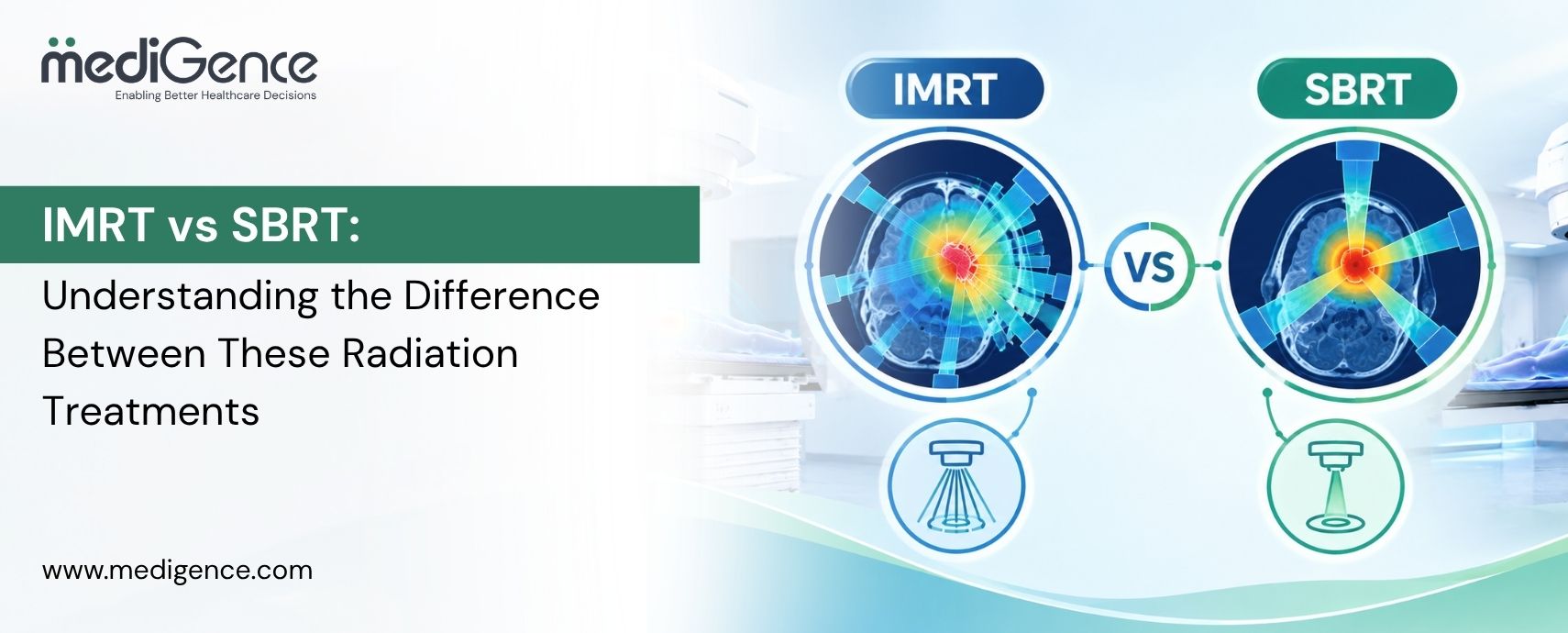
Although IMRT and SBRT are often compared, they describe different aspects of radiation treatment.
IMRT mainly refers to how radiation beam intensity is controlled and how the radiation dose is shaped around the treatment area. SBRT is a highly precise treatment approach that generally uses higher doses per session over a limited number of sessions.
Feature | IMRT | SBRT |
Full form | Intensity-modulated radiation therapy | Stereotactic body radiation therapy |
Main principle | Control radiation intensity to match the shape of the cancer. | Delivers highly concentrated target radiation to a single tumour. |
Number of sessions | Completed in 1 to 5 visits, usually over 1 to 2 weeks | Fewer sessions over a 1-5 treatment plan. |
Precision | Highly conformal dose delivery | Very high stereotactic precision |
Use | Used across a range of cancer treatment settings | Used for selected clinical situations |
Suitablity | Used for selected clinical situations | Requires careful patient and tumour selection |
Both IMRT and SBRT are used to treat cancer but are suitable for different treatment situations. IMRT is useful when radiation must be precisely shaped around a tumor, particularly if sensitive organs are nearby. In contrast, SBRT is generally used for selected, well-defined tumours that can be treated with a higher dose of radiation in fewer sessions.
This choice depends on the tumour type, size, and location; surrounding organs; previous treatments; and the overall treatment goal. In some cases, SBRT can also be delivered with IMRT-based techniques.
No single option is best for everyone. Your radiation oncologist may consider:
Your final choice depends on your individual condition and the need to deliver radiation as precisely and safely as possible.
Explore cancer hospitals in India to compare available oncology services, hospital facilities, and treatment options. Trusted by 100000+ patients and leading medical experts. Explore Your Brain Tumour Treatment Options

Before starting treatment, the treatment team will use imaging scans, such as a CT scan or the appropriate test, to identify the exact location of the tumour and plan how the radiation will be delivered. You may also have a simulation session to help position your body properly during treatment.
During each session, you will lie on the treatment table, and the radiation team will use imaging or other guidance methods to check your position. You usually won't feel the radiation, and the treatment is generally painless.
The main difference is the number of treatment sessions required. IMRT is often delivered in multiple sessions, while SBRT is usually delivered in fewer sessions with a larger dose per session. The exact schedule depends on the cancer, the area being treated, and the individual factors.
After treatment, your radiation oncologist will monitor your response and any side effects. These can vary by area treated, radiation dose, and your individual health.
IMRT and SBRT are both precise approaches to external beam radiation, but they differ in how they plan and deliver radiation.
IMRT shapes the radiation dose to the treatment site and modulates beam intensity. SBRT usually delivers a relatively large dose of radiation in a small number of treatments to a precisely defined target.
The two approaches should not be viewed as simply "less advanced" versus "more advanced". In certain situations, IMRT might be suitable; in others, SBRT can be considered, and the approaches can also overlap.
The more useful question for the patient is not just which technique sounds better, but which radiation treatment is appropriate for their specific cancer, tumour location, treatment goal, and overall health.
SBRT generally uses a higher radiation dose per treatment session than conventional radiation schedules. However, describing it as simply “more powerful” does not mean it is better for every patient. The appropriate treatment depends on the cancer and the individual clinical situation.
The number of IMRT sessions varies by cancer, treatment goal, radiation dose, and treatment plan. It generally takes up to weeks, although no single number of sessions applies to every patient.
Side-effect risk depends on factors such as the treatment site, dose, fractionation, tumour location, surrounding organs, and individual patient factors.
SBRT generally uses fewer treatment sessions than many conventional radiation schedules. The exact number depends on the cancer, tumour location, treatment plan, and clinical circumstances.
The specific risks depend on the exposed body parts; common side effects may include hair loss at the treatment site, skin irritation, tiredness, nausea, and body part-specific effects such as mouth or throat problems when the head and neck are treated, or bowel and bladder symptoms when the pelvis is treated. In some cases, side effects may also occur later after the treatment.

Pragun Gupta is a Doctor of Pharmacy (Pharm. D.) professional from Teerthanker Mahaveer University with hands-on experience in clinical pharmacology, clinical research, and evidence-based medical writing. Through her clinical and research exposure, she has developed a strong interest in pharmacoeconomics, pharmacology, therapeutics, and pharmacovigilance. As a medical writer, she works on medical and scientific research articles, patient education materials, and healthcare-focused content. Her clinical research and evidence-based writing experience enables her to translate complex medical information into clear, accurate, patient-friendly content while maintaining scientific credibility and medical accuracy. Her primary aim is to make healthcare information accessible and easy for patients and general readers to understand.

Dr. Prateek Varshney is a renowned Surgical Oncologist. He has experience of more than 15+ years in surgical Oncology. He is currently practising as a consultant at Metro Mass Hospital and Cancer Institute. He was also previously associated as a consultant with Sir Ganga Ram Hospital and as a professor at Gujarat Cancer Research Institute.





Delhi, India

Istanbul, Turkey

Istanbul, Turkey

Istanbul, Turkey
 Active




.jpg)

