Browse verified doctors or let our care team help you find the doctor best suited to your condition, treatment goals, and budget.

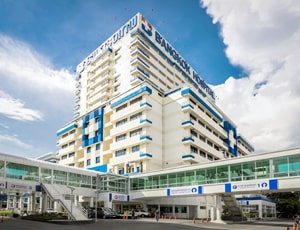
Bangkok Hospital provides specialized TLIF with a focus on spinal stabilization, nerve decompression when required, and individualized surgical care. Established in 1972, the JCI accredited hospital is located in Bangkok, Thailand and operates 580 beds with modern spine-care infrastructure.
TLIF (Transforaminal Lumbar Interbody Fusion) is a lumbar spine procedure that combines disc removal, interbody fusion, and spinal fixation. It can be used for selected patients with conditions that cause instability or significant symptoms, particularly when conservative treatment has not provided adequate relief. The surgeon approaches the affected disc through the back and one side of the spine, removes the damaged disc, and places an interbody implant with bone graft material. Pedicle screws and connecting rods may be used to stabilize the treated levels while the bone fusion develops. Pre-operative imaging and neurological assessment help determine the appropriate surgical plan.
At Vejthani Hospital, TLIF is performed using advanced spinal implants, surgical navigation, and personalized treatment planning. Established in 1994, this JCI accredited hospital in Bangkok, Thailand has 263 beds and offers comprehensive orthopedic and neurosurgical services.
TLIF may be recommended for selected patients with lumbar spinal instability, persistent pain, or nerve compression associated with structural spinal disorders. Through a posterior approach, the surgeon accesses the affected disc space from one side, removes the damaged disc material, and inserts an implant containing bone graft material. The procedure can also allow the surgeon to decompress affected nerve roots when necessary. Instrumentation such as pedicle screws and rods helps maintain spinal alignment during the fusion process.
Bangpakok 9 International Hospital offers advanced TLIF (Transforaminal Lumbar Interbody Fusion) using modern spinal surgery techniques and individualized treatment protocols. Established in 2003, the JCI, GHA accredited hospital is located in Bangkok, Thailand and has 300 beds, providing comprehensive spine care for local and international patients.
TLIF is a surgical technique used to stabilize the lumbar spine and treat selected conditions involving damaged discs or spinal instability. During the procedure, the surgeon approaches the spine from the back through one side, removes the affected intervertebral disc, and places a bone graft or interbody cage into the disc space. Screws and rods are generally used to provide additional stability while the vertebrae fuse. TLIF may be considered for conditions such as spondylolisthesis, recurrent disc problems, or degenerative spinal disease.
Phyathai 2 International Hospital provides specialized TLIF with a focus on spinal stabilization, nerve decompression when required, and individualized surgical care. Established in 1987, the JCI accredited hospital is located in Bangkok, Thailand and operates 550 beds with modern spine-care infrastructure.
TLIF (Transforaminal Lumbar Interbody Fusion) is a lumbar spine procedure that combines disc removal, interbody fusion, and spinal fixation. It can be used for selected patients with conditions that cause instability or significant symptoms, particularly when conservative treatment has not provided adequate relief. The surgeon approaches the affected disc through the back and one side of the spine, removes the damaged disc, and places an interbody implant with bone graft material. Pedicle screws and connecting rods may be used to stabilize the treated levels while the bone fusion develops. Pre-operative imaging and neurological assessment help determine the appropriate surgical plan.
Krabi Nakharin International Hospital offers advanced TLIF (Transforaminal Lumbar Interbody Fusion) using modern spinal surgery techniques and individualized treatment protocols. Established in 1997, the JCI accredited hospital is located in Krabi, Thailand and has 150 beds, providing comprehensive spine care for local and international patients.
TLIF is a surgical technique used to stabilize the lumbar spine and treat selected conditions involving damaged discs or spinal instability. During the procedure, the surgeon approaches the spine from the back through one side, removes the affected intervertebral disc, and places a bone graft or interbody cage into the disc space. Screws and rods are generally used to provide additional stability while the vertebrae fuse. TLIF may be considered for conditions such as spondylolisthesis, recurrent disc problems, or degenerative spinal disease.
At Kasemrad Ramkhamhaeng Hospital, TLIF is performed using advanced spinal implants, surgical navigation, and personalized treatment planning. Established in 1992, this JCI accredited hospital in Bangkok, Thailand has 120 beds and offers comprehensive orthopedic and neurosurgical services.
TLIF may be recommended for selected patients with lumbar spinal instability, persistent pain, or nerve compression associated with structural spinal disorders. Through a posterior approach, the surgeon accesses the affected disc space from one side, removes the damaged disc material, and inserts an implant containing bone graft material. The procedure can also allow the surgeon to decompress affected nerve roots when necessary. Instrumentation such as pedicle screws and rods helps maintain spinal alignment during the fusion process.
At BNH Hospital, Bangkok, TLIF is performed using advanced spinal implants, surgical navigation, and personalized treatment planning. Established in 1898, this JCI accredited hospital in Bangkok, Thailand has 150 beds and offers comprehensive orthopedic and neurosurgical services.
TLIF may be recommended for selected patients with lumbar spinal instability, persistent pain, or nerve compression associated with structural spinal disorders. Through a posterior approach, the surgeon accesses the affected disc space from one side, removes the damaged disc material, and inserts an implant containing bone graft material. The procedure can also allow the surgeon to decompress affected nerve roots when necessary. Instrumentation such as pedicle screws and rods helps maintain spinal alignment during the fusion process.

Emily's story is a powerful reminder that with the right guidance, expert medical care, and personalised rehabilitation, even long-standing pain can be overcome.
| Speciality | Orthopedics |
| Procedure | TLIF |
| Success Rate | 85-95% |
| Recovery Time | 2-4 months |
| Treatment Time | 2-3 hours |
| Chances of Recurrence | Low |
Transforaminal Lumbar Interbody Fusion (TLIF) is a surgical procedure used to treat certain spinal conditions affecting the lumbar (lower) region of the spine. The surgeon enters the spine from the side during TLIF to remove damaged disc material and insert bone grafts into the intervertebral space. This promotes vertebral fusion, which stabilizes the spine and relieves nerve pressure.
Medical conditions that can be treated through TLIF include degenerative disc disease, herniated discs, spinal stenosis, and spondylolisthesis.
After a TLIF, the recovery process includes a few days in the hospital to monitor healing and manage pain. To regain strength and flexibility, patients will gradually resume light activities and physical therapy. A back brace may be used at first to support the spine during the healing process. The total recovery time varies, but it usually takes several months for the bone to fuse completely. Following postoperative instructions is extremely important for a quick recovery.
A number of determining factors can be used to rank hospitals for your suitable procedure. To rank these hospitals in Thailand for TLIF, take the following aspects into account- Popularity for the Procedure, Infrastructure, Accessibility of the treatment, Qualified Medical Personnel, Technology Used, Price, Amenities provided, and Success Rate.
MediGence provides you with a combination of cost-savings, convenience, and quality healthcare. With us, you can receive top-notch medical treatment while saving money and making your journey hassle-free with some unmatched benefits & services. Some of the best caregiving services are Online consultation, Hotel Stays or Accommodation, Case Manager, Recovery Packages, 24/7 assistance, and Individually-crafted Packages with upto 30% savings. Furthermore, we have alot more other benefits for you to recieve top-notch medical care.
Yes. MediGence gives you the privilege of scheduling an online consultation with a specialist in Thailand. When our patient advisors connect with you regarding your query, you can place your request of having an online consultation with the specialist. They will check the doctor's availability for the consultation. Once confirmed, you will be sent a payment link to book your online consultation.
Thailand is becoming a prime destination for many people across the world for TLIF because of high success rates and modern infrastructure. There are many additional factors making Thailand the preferred choice for TLIF including:
The recovery time for a procedure varies based on the condition of the patient and the complexity of the surgery. Additionally, post-treatment rehabilitation is crucial for accelerating recovery and cutting down on recovery time. Patients must go back for follow-up appointments after surgery in order to ensure proper healing and speed up the healing process.