Browse verified doctors or let our care team help you find the doctor best suited to your condition, treatment goals, and budget.

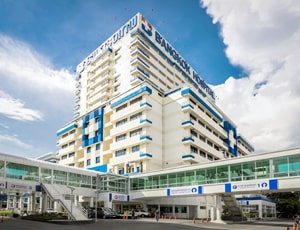
Choosing Bangkok Hospital for Capsule Endoscopy gives patients access to non-invasive gastrointestinal imaging, specialist interpretation, and comprehensive diagnostic support. Established in 1972, the JCI accredited hospital is located in Bangkok, Thailand and operates 580 beds with modern gastroenterology facilities.
Capsule Endoscopy provides a detailed view of sections of the small bowel that may be difficult to reach with standard endoscopic procedures. The patient swallows a disposable capsule equipped with a tiny camera and light source, which records images as it moves through the intestine. The captured information is transmitted to a recording device and reviewed by a gastroenterologist. Before the procedure, doctors assess factors such as swallowing ability and the possibility of intestinal narrowing that could prevent the capsule from passing normally.
Vejthani Hospital provides specialized Capsule Endoscopy with a focus on detailed visualization of the small intestine, accurate diagnosis, and comfortable patient evaluation. Established in 1994, the JCI accredited hospital is located in Bangkok, Thailand and operates 263 beds with advanced gastroenterology and diagnostic facilities.
Capsule Endoscopy is a minimally invasive procedure in which the patient swallows a small capsule containing a miniature camera. As the capsule naturally travels through the digestive tract, it captures images of the gastrointestinal lining, particularly areas of the small intestine that can be difficult to examine using conventional endoscopy. It may be recommended to investigate unexplained gastrointestinal bleeding, suspected Crohn's disease, or other small-bowel abnormalities. The capsule is normally passed naturally through the stool after completing its journey.
Bangpakok 9 International Hospital offers dedicated Capsule Endoscopy supported by experienced gastroenterologists, advanced imaging systems, and modern diagnostic infrastructure. Established in 2003, the JCI, GHA accredited hospital is situated in Bangkok, Thailand and has 300 beds providing specialized gastrointestinal care.
Capsule Endoscopy is commonly used when a detailed examination of the small intestine is needed. After swallowing the capsule, its camera records multiple images while it passes naturally through the digestive tract. The procedure can be particularly useful for evaluating suspected small-bowel bleeding, inflammatory bowel disease, or unexplained anaemia when other investigations have not identified the cause. Patients generally continue normal activities according to their doctor's instructions while the capsule travels through the digestive system.
Choosing Phyathai 2 International Hospital for Capsule Endoscopy gives patients access to non-invasive gastrointestinal imaging, specialist interpretation, and comprehensive diagnostic support. Established in 1987, the JCI accredited hospital is located in Bangkok, Thailand and operates 550 beds with modern gastroenterology facilities.
Capsule Endoscopy provides a detailed view of sections of the small bowel that may be difficult to reach with standard endoscopic procedures. The patient swallows a disposable capsule equipped with a tiny camera and light source, which records images as it moves through the intestine. The captured information is transmitted to a recording device and reviewed by a gastroenterologist. Before the procedure, doctors assess factors such as swallowing ability and the possibility of intestinal narrowing that could prevent the capsule from passing normally.
Choosing Yanhee International Hospital for Capsule Endoscopy gives patients access to non-invasive gastrointestinal imaging, specialist interpretation, and comprehensive diagnostic support. Established in 1984, the ISO, JCI accredited hospital is located in Bangkok, Thailand and operates 400 beds with modern gastroenterology facilities.
Capsule Endoscopy provides a detailed view of sections of the small bowel that may be difficult to reach with standard endoscopic procedures. The patient swallows a disposable capsule equipped with a tiny camera and light source, which records images as it moves through the intestine. The captured information is transmitted to a recording device and reviewed by a gastroenterologist. Before the procedure, doctors assess factors such as swallowing ability and the possibility of intestinal narrowing that could prevent the capsule from passing normally.
Sikarin Hospital offers dedicated Capsule Endoscopy supported by experienced gastroenterologists, advanced imaging systems, and modern diagnostic infrastructure. Established in 1979, the JCI accredited hospital is situated in Bangkok, Thailand and has 354 beds providing specialized gastrointestinal care.
Capsule Endoscopy is commonly used when a detailed examination of the small intestine is needed. After swallowing the capsule, its camera records multiple images while it passes naturally through the digestive tract. The procedure can be particularly useful for evaluating suspected small-bowel bleeding, inflammatory bowel disease, or unexplained anaemia when other investigations have not identified the cause. Patients generally continue normal activities according to their doctor's instructions while the capsule travels through the digestive system.
Choosing Sukumvit Hospital, Bangkok for Capsule Endoscopy gives patients access to non-invasive gastrointestinal imaging, specialist interpretation, and comprehensive diagnostic support. Established in 1977, the JCI accredited hospital is located in Bangkok, Thailand and operates 280 beds with modern gastroenterology facilities.
Capsule Endoscopy provides a detailed view of sections of the small bowel that may be difficult to reach with standard endoscopic procedures. The patient swallows a disposable capsule equipped with a tiny camera and light source, which records images as it moves through the intestine. The captured information is transmitted to a recording device and reviewed by a gastroenterologist. Before the procedure, doctors assess factors such as swallowing ability and the possibility of intestinal narrowing that could prevent the capsule from passing normally.
| Speciality | Gastroenterology |
| Procedure | Capsule Endoscopy |
| Success Rate | 95-98% |
| Recovery Time | 1-2 days |
| Treatment Time | 30 minute |
| Chances of Recurrence | NA |
Hospitals for any type of procedure can be ranked on several deciding aspects. In Thailand, Hospitals for Capsule Endoscopy are ranked on the basis of the following factors- Infrastructure, procedure accessibility, procedure popularity, Technology, Cost-effectiveness, Experienced Doctors, Patient-care Facilities, and Success Rate
MediGence works incredibly diligently to ensure that you get the best possible medical travel experience that is also accessible and reasonable. While travelling for treatment abroad, MediGence makes sure that your healthcare journey should be smooth and hassle-free. Some of our notable services include Hotel stays or accommodation, Video consultation, dedicated case manager, round-the-clock help, airport transfers, and customized prebundled treatment packages with discount of up to a 30%. Many more benefits are available with MediGence your treatment abroad.
Absolutely! Yes. Before you plan medical travel to Thailand, you can benefit from an efficient & helpful online consultation with the chosen specialist there. While talking to one of our experts, you can request a video consultation appointment. They will finalize your appointment after confirming the doctor's availability and sending the payment link.
Due to the country's cutting-edge healthcare system and high success rate, many people have begun traveling to Thailand for Capsule Endoscopy. In addition, there are other parameters that make Thailand the ideal option for Capsule Endoscopy. They include:
Depending on the patient's health and the complexity of the treatment, different procedures have different recovery times. Other factors like continuously taking rehab sessions and enrolling in postoperative care sessions also greatly impact the recovery time of the patient. Patient must keep in touch with their surgeon for a few months after surgery in order to speed up recovery.