Ependymoma Treatment in India
- Top Accredited Hospitals
- Global Medical Standards
- Cutting-Edge Technology
- Proven Treatment Options
- High Success Rate
- Trusted by Millions

What is an Ependymoma?
Ependymoma is a type of central nervous system (CNS) tumor that develops from ependymal cells, which line the ventricles of the brain and the central canal of the spinal cord. It can occur in both children and adults and may develop in different areas of the brain or spinal cord. Modern classification increasingly incorporates molecular characteristics and tumor location, in addition to microscopic features, to define different ependymoma types.
What is the Importance of Timely Treatment?
Timely diagnosis and treatment are important because an ependymoma can compress or infiltrate nearby brain or spinal cord structures and may obstruct the normal flow of cerebrospinal fluid (CSF). Depending on its location and behaviour, the tumor can cause increased intracranial pressure, neurological impairment, hydrocephalus or spinal cord dysfunction. Early specialist evaluation helps determine the appropriate treatment strategy.
What are the Common Symptoms of an Ependymoma?
- Headache
- Nausea and vomiting
- Problems with balance or coordination
- Difficulty walking
- Seizures
- Vision changes
- Weakness or numbness
- Back or neck pain in spinal tumors
- Limb weakness or sensory changes
- Changes in bladder or bowel function with spinal involvement
- Hydrocephalus-related symptoms
- Cognitive or behavioural changes in some brain tumors
Causes and Risk Factors of Ependymoma
Causes
- The exact cause of most ependymomas is unknown. These tumors arise from genetic and molecular changes in ependymal cells, but in most patients there is no clearly identifiable environmental or lifestyle cause.
- Some ependymomas have characteristic molecular alterations that help define their tumor subtype.
Risk Factors
- Childhood or young age for certain ependymoma subtypes
- Certain genetic conditions, particularly neurofibromatosis type 2 (NF2), which is associated with an increased risk of ependymal tumors
- Specific molecular or genetic alterations within tumor cells
Latest Research and Technologies in the Treatment of Ependymoma in India
Ependymoma treatment is increasingly guided by molecular classification, tumor location, age, extent of surgical removal and disease dissemination. Modern pathology can identify molecular subgroups that provide information about tumor biology and prognosis. Advanced MRI techniques help define tumor anatomy and guide surgical planning.
Current treatment research includes improved molecular classification, targeted approaches for specific tumor alterations, precision radiation techniques and clinical trials investigating new therapies. For selected patients, advanced radiation techniques such as intensity-modulated radiation therapy (IMRT), proton therapy or stereotactic approaches may help deliver radiation while limiting exposure to surrounding healthy tissues.
Treatment options for Ependymoma
Brain cancer surgery (craniotomy) : It is the primary treatment to diagnose, reduce the size of, or completely remove a brain tumor. The main goal is to safely remove as much of the tumor as possible while preserving vital brain functions like speech, movement, and cognitive abilities.
Cost Start From 4500Explore Options
Radiation Therapy : Radiation may be recommended after surgery for selected tumors, particularly when residual disease remains or when tumor characteristics indicate a higher risk of recurrence.
Cost Start From 2500Explore Options
Chemotherapy : It has a limited role in many newly diagnosed ependymomas but may be considered in selected situations, particularly in children or recurrent disease when other treatment options are limited.
Cost Start From 300Explore Options
Treatment for Recurrent Disease: Recurrent ependymoma may require additional surgery, radiation, systemic therapy or a combination of approaches depending on the location and previous treatments.
Multidisciplinary and Supportive Care: Neurology, neurosurgery, radiation oncology, pediatric oncology, rehabilitation and supportive-care specialists may work together to address tumor control, neurological function and quality of life.
- Clinical assessment:
- Evaluation begins with a detailed medical history and neurological examination. Doctors assess symptoms such as headaches, seizures, balance problems, weakness, sensory changes, walking difficulties and bladder or bowel dysfunction.
- For children, doctors may also evaluate developmental progress, school performance, and changes in behaviour.
- Definitive diagnosis generally requires examination of tumor tissue obtained through surgery or biopsy. Pathological and molecular testing can help determine the ependymoma subtype and guide treatment planning.
- Imaging Tests:
- MRI Brain: Provides detailed visualisation of intracranial ependymomas and their relationship with surrounding structures.
- MRI Spine: Important for spinal ependymomas and for assessing possible dissemination through the CSF pathways.
- Contrast-Enhanced MRI: Helps define tumor margins, enhancement patterns and residual or recurrent disease.
- CT Scan: May be used in selected situations, particularly when MRI is unavailable or additional structural information is needed.
- Spinal Imaging/Neuraxis MRI: May be performed to assess for tumor spread along the brain and spinal cord.
- CSF assessment: In selected patients, cerebrospinal fluid examination may be performed after imaging or surgery to evaluate possible tumor dissemination.
MediRehab (a chain of Rehab centres, part of MediGence) provides comprehensive rehabilitation services designed to support Ependymoma patients in India. These services include:
- Physiotherapy: Helps improve strength, balance, coordination and mobility when the tumor or treatment has affected movement.
- Occupational Therapy: Supports independence with daily activities and helps patients adapt to physical or neurological limitations.
- Speech and Swallowing Therapy: May be recommended when a brain tumor or its treatment affects speech, communication or swallowing.
- Neurorehabilitation: Structured rehabilitation can address motor, cognitive and functional difficulties following surgery or other neurological complications.
- Long-Term Functional Support: Ongoing rehabilitation, nutritional support, psychological care and neurological follow-up may help patients manage persistent or changing functional needs.
- Medicines do not usually eliminate a localised ependymoma but may be used to manage symptoms and treatment-related complications. Corticosteroids may be prescribed to reduce brain or spinal cord swelling around the tumor, while anti-seizure medicines may be used in patients who experience seizures. Pain medicines, anti-nausea medicines and other supportive treatments may also be required. Chemotherapy may be considered in selected recurrent or difficult-to-treat cases, particularly in pediatric patients, but its role varies according to tumor subtype and clinical circumstances.
Instantly Connect with our Specialists


Hospitals for Ependymoma in India

Indraprastha Apollo Hospital
Delhi, India
Indraprastha Apollo Hospital is known for delivering treatment to over 200,000 patients every year; 10,000 of which are generally medical tourists. The efficient team of doctors has the record of 99.6 percent success rate. Indraprastha Apollo Hospital deals in treatment of over 50 specialities.
Let’s see some of the features of the infrastructure:
- Spread over 15 acres, the hospital has 710 beds.
- 6 beds dedicated to bone marrow transplant units with very strict infection control practices.
- 64-Slice Scan coupled with data acquisition which provides highest temporal resolution
- One of the hospitals to be using Da Vinci Robotics Surgery System
- In South Asia, the Spect-CT and Pet-CT got their first installation at Indraprastha Apollo Hospital in India
- Technologies such as PET- MR, BrainLab Navigation System, PET-CT, Portable CT Scanner, Tilting MRI, NovalisTx, Cobalt based HDR Brachytherapy, Hyperbaric Chamber, DSA Lab, Fibroscan, 3 Tesla MRI, Endosonography, 128 Slice CT scanner are all installed at the hospital.
- The Cancer Institute at Indraprastha Apollo is equipped with a highly advanced Radiation Oncology Center with ClinaciX, NovalisTx, and HDR-Brachytherapy.
- It is equipped with the largest Sleep Lab in Asia, & has one of the largest Dialysis Units in India.
- A large number of ICU beds than any other Private Hospitals in India.
- WIFI is accessible across the whole campus.

Manipal Hospital, Yeshwantpur
Bangalore, India
Manipal Hospital, Yeshwantpur located in Bengaluru, India is accredited by NABH. Also listed below are some of the most prominent infrastructural details:
- Super-specialty healthcare facility
- Started operations in July 2008
- Video consultations with specialists
- Various health checkup packages available
- Technological applications in healthcare and healthcare delivery
- Many ancillar services available like
- ICU, NICU
- Physiotherapy
- Referral lab
- Teleradiology / telemedicine
- Pharmacy
- Imaging facilities
- Rehabilitation services, 24 hour emergency services, operating theatre, ambulatory and daycare, cafeteria, and many kinds of patient accomodation.
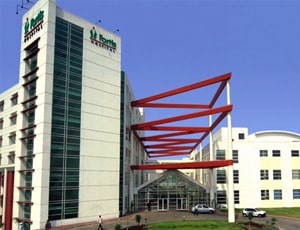
Fortis Hospital
Noida, India
Fortis Healthcare Limited is one of India’s prominent providers of integrated healthcare services, offering comprehensive medical care across multiple specialities. The company’s operations span hospitals, diagnostic centres, and day-care speciality facilities, ensuring a wide range of healthcare solutions under one umbrella. Fortis has established a strong presence across the country, managing 33 healthcare facilities, which include joint ventures and operational & management (O&M) setups, across 11 states.
The company’s hospital network comprises more than 5,700 operational beds, including O&M beds, catering to patients with varied healthcare needs. In addition to inpatient services, Fortis operates around 400 diagnostic laboratories, providing reliable and timely diagnostic support for accurate medical care. This extensive network enables Fortis to deliver high-quality healthcare services consistently and efficiently, from routine diagnostics to specialised treatments and complex procedures.
Our Services to better your experience
Opinion & Option
We submit the most accurate opinion and options from one or more countries for your review
Consult Privately
Consult with a certified specialist privately on our telemedicine platform even before you decide to travel
Logistics
We handle flights, visas, transfers, and accommodation—so you can focus on your health.
Recovery
Our In-house rehabilitation service packages to better your recovery and treatment outcome
Why Choose India for Ependymoma Treatment?
- Experienced Neuro-Oncology Teams: Patients can access multidisciplinary teams involving neurosurgeons, neuro-oncologists, radiation oncologists, neurologists and rehabilitation specialists.
- Advanced Neuroimaging and Molecular Diagnosis: Major centres may offer high-resolution MRI, neuraxis imaging, advanced pathology and molecular testing to support tumor classification.
- Advanced Neurosurgical Techniques: Selected patients may have access to image-guided and minimally invasive neurosurgical approaches designed to achieve maximal safe tumor removal.
- Modern Radiation Therapy: Appropriate patients may have access to techniques such as IMRT, stereotactic radiation and proton therapy where available.
- Comprehensive Rehabilitation and International Support: Rehabilitation services and international-patient departments can support recovery, follow-up and treatment coordination.