Acute lymphoblastic leukemia (ALL) Treatment in Thailand
- Top Accredited Hospitals
- Global Medical Standards
- Cutting-Edge Technology
- Proven Treatment Options
- High Success Rate
- Trusted by Millions

What is Acute lymphoblastic leukaemia (ALL)?
Acute Lymphoblastic Leukemia (ALL) is a malignancy involving the blood and bone marrow and is characterised by the abnormal growth of immature white blood cells (lymphoblasts). The incidence peaks in children, and adults may also be diagnosed with it.
What is the Importance of Timely Treatment?
- Improved Survival Rates: The sooner the diagnosis of ALL is made and treatment begins, the stronger the possibility that it will result in remission and long-term survival.
- Prevention of Complications: It results in serious complications, such as infection, bleeding, or disturbance in organ function. Prompt treatment thus reduces the chance of such life-threatening conditions, brings disease control, and develops the immune response.
- Better Response to Treatment: The earlier the intervention for acute lymphoblastic leukaemia, the more probable it is for the patient to respond favourably to chemotherapy, stem cell transplantation, or other therapeutic regimes.
- Reduced risk of Relapse: Timely and aggressive treatment should ensure complete remission, reducing the chance of relapse. Earlier detection makes all of them easier to treat, with relapse prevention being critical for long-term outcomes.
- Quality of life: The patient is expected to suffer fewer side effects and enjoy an increased quality of life during and after treatment due to early diagnosis and treatment.
What are the Common Symptoms of Acute Lymphoblastic Leukemia (ALL)?
- Fatigue and Weakness
- Pale Skin
- Frequent Infections or Fever
- Easy Bruising or Bleeding
- Swollen Lymph Nodes
- Bone or Joint Pain
- Loss of Appetite or Unexplained Weight Loss
- Shortness of Breath or Dizziness
- Abdominal Pain or Fullness
Causes and Risk Factors of Acute Lymphoblastic Leukemia (ALL)
Causes
- Genetic Mutations
- Chromosomal Abnormalities
- Infections
- Immune System Disorders
- Exposure to Radiation or Chemicals
Risk Factors
- Age
- Family History
- Previous Cancer Treatment
- Environmental Exposures
- Genetic Syndromes
Connect with our advisor for a PRIORITY response
Latest Research and Technologies in the Treatment of Acute Lymphoblastic Leukemia (ALL) in Thailand
Cancer centres have embraced the new CAR-T Cell Therapy being introduced into Thailand for patients suffering from relapsed or refractory ALL. Concentrated on a much more limited area of management requiring minimal side effects, targeted therapies, monoclonal antibodies, and targeted treatments. Precision medicine and genetic profiling made individualised treatment plans possible to improve a patient's health profile toward more extended survivorship. Enhanced minimally invasive approaches and improved supportive care now enable safer and more comfortable approaches to care.
Acute lymphoblastic leukemia (ALL) Prevention Tip:
- Radiation avoidance exposure: Minimize exposure from medical imaging radiation; high doses are associated with risk for ALL. They should be used to radiate only those individuals who are medically indicated.
- Protection from Harmful Chemicals: Long-term or repetitive exposure to chemicals such as benzene (mostly from industrial sources and some household products) and pesticides can be injurious and related to incidences of leukemia.
- Healthy Lifestyle Choices: Healthy living practices such as keeping a healthy lifestyle with a balanced diet, exercising, and habitually avoiding tobacco smoking may still boost overall health and the immune system to prevent some cancers.
- Regular Medical Check-ups: Early detection matters. A regular check-up can identify unusual symptoms early so that if someone develops leukaemia, he or she will have a higher chance of successful treatment.
- Genetic Counseling: A genetic counsellor might inform people about future risks and early follow-ups to find loopholes, whereas such information is shared with people with existing leukaemia or heritable conditions such as Down syndrome.
Treatment options for Acute lymphoblastic leukemia (ALL)
The medical treatment for Acute lymphoblastic leukaemia (ALL) requires evaluating the patient's severity and medical condition. The following are the treatment options:
Chemotherapy : Chemotherapy for ALL always comes first: induction chemotherapy for remission, consolidation and maintenance chemotherapy to prevent relapse and maintain the remission.
Cost Start From USD 1000 - USD 6800Explore Options
Targeted Therapy : Tyrosine Kinase Inhibitors (TKIs), such as Imatinib, are used in Philadelphia chromosome-positive ALL, along with monoclonal antibodies, which target leukaemia cells and stimulate the immune response.
Cost Start From USD 3500Explore Options
Stem Cell Transplantation : Allogeneic transplants from matched donors or autologous (using the patient's cells) are an option for high-risk or relapsed cases to restore normal blood cell production.
{stem-cell-therapy}Immunotherapy : CAR-T cell therapy, a promising approach for patients with relapsed ALL, involves engineering the patient's T-cells to target and kill leukaemia cells. Immune checkpoint inhibitors are being explored to augment immune response against leukaemia.
Cost Start From USD 3000 - USD 13578Explore Options
Radiation Therapy and Supportive Care: CNS-directed radiation is indicated for leukaemias that go into the brain, while supportive care measures such as blood transfusions and prevention of infections can help ameliorate side effects and improve the patient's outcome during treatment.
CAR-T Cell Therapy : It emerges as a revolutionised therapy for patients with Acute Lymphoblastic Leukemia (ALL), particularly for patients with minimal responses to conventional treatment.
Cost Start From USD 150000 - USD 470000Explore Options
These are the standard diagnostic methods for diagnosing Acute lymphoblastic leukaemia (ALL):
Imaging Studies
- Chest X-ray or CT scans are utilised for the assessment of enlarged lymph nodes, spleen, liver, or other organ manifestations with potentially proven blood dissemination of leukaemia.
- Ultrasound: It evaluates organ enlargement, especially in the liver or spleen, which are commonly affected by leukaemia.
Blood Tests
- Complete Blood Count (CBC): CBC abnormalities can be seen in the levels of white blood cells, red blood cells, and platelets of a person having leukaemia. It manifests common signs of low blood counts, especially anaemia and thrombocytopenia.
- Peripheral Blood Smear: Under a microscope, a smear is made by spreading blood on a slide to check for immature white blood cells, known as blast cells, which are typical of ALL.
Bone Marrow Biopsy
- A core needle biopsy from the hip bone to take a marrow sample for the presence of leukaemia cells. Blood cells are manufactured in the bone marrow, with leukemic cells displacing the healthy population and forming blood.
Lumbar Puncture (Cerebrospinal Fluid Analysis)
- Lumbar punctures (spinal taps) are done to see if leukaemia has spread into the central nervous system (CNS). During such an operation, a portion of cerebrospinal fluid (CSF) is extracted from the region surrounding the spinal cord and the brain to search for signs of leukaemia cells.
MediRehab (a chain of Rehab centres, part of MediGence) provides comprehensive rehabilitation services to support patients through Teleconsulations and online therapy sessions.
- Rehabilitation: The purpose of physical therapy in the recovery process is to regain mobility and strength after chemotherapy or a stem cell transplant.
- Occupational Therapy: Occupational therapy assists patients in reclaiming familiar daily living skills such as dressing and cooking. It also gives skills in overcoming those cognitive challenges brought about by chemotherapy or radiation, thus improving mental function.
- Psychological Support: There is a need for emotional support, learning therapy, and support groups for patients suffering from the stress involved in all treatments.
- Lifestyle Modification: Counseling from a dietitian will involve the creation of individualised meal plans to cope with symptoms such as loss of appetite, nausea, and other treatment effects.
- Pain Relief: Pain relief programs such as medication, acupuncture, and massage therapy are designed to ease the patient's discomfort resulting from treatment.
Instantly Connect with our Specialists


Hospitals for Acute lymphoblastic leukemia (ALL) in Thailand

Vejthani Hospital
Bangkok, Thailand
Vejthani Hospital located in Bangkok, Thailand is accredited by NABH, NABL. Also listed below are some of the most prominent infrastructural details:
- It is among the topmost private hospitals functioning in Thailand.
- The bed capacity of the hospital is 263.
- There are more than three hundred thousand patients visiting the hospital every year.
- Vejthani hospital has more than 40 outpatient clinics and centers.
- International patient care center with all kinds of services: air ambulance, transfers, travel, stay, embassy liaison, patient coordinators, prayer rooms, visa coordination and translators for 20 languages.
- The special facilities are:
- International Certified Laboratory
- 10 Operating Rooms
- Radiology Section: Portable X-ray, CT-scan and C-ARM and MRI
- Neonatal Critical Care Unit
- Water-jet technique applied for liposuction
- Computer navigation and mini-invasive technique for Joint Replacement surgery

Bangpakok 9 International Hospital
Bangkok, Thailand
Bangpakok 9 International Hospital located in Bangkok, Thailand is accredited by JCI. Also listed below are some of the most prominent infrastructural details:
- It would be prudent to summarise the Medical Services provided at the Bangpakok 9 International Hospital (BPK 9), Bangkok, Thailand:
- Cosmetic Dentistry
- Dental Implants
- Electrocardiogram (EKG or ECG)
- Exercise Stress Test
- Health Screening
- Laser Vagina Firming
- Pediatric Physical Therapy
- Perfect Slim by Vela II
- Physical Therapy for Musculoskeletal
- Prosthodontics
- The Medical Services are also inclusive of the International Patient Services such as the ones listed here:
- Thai, English, French, Arabic, Chinese, Myanmar, Cambodia, Bangladeshi, Bahasa and Tagalog are the languages in which there are Translation services available for International Patients.
- Visa extension related assistance
- International health insurance related assistance
- Embassy and international organizations related assistance
- A variety of meals of choice for International Patients
- Email consultation services
- Transfer to either airport and/or hotels
- Prayer room
- Four different types of rooms are available such as Deluxe room, two kinds of suites, and a VIP suite.
- Hospital facilities like The Coffee shop, Food Hall, Cafe and Medical Spa.
- Complete health and safety protocols are maintained in the various Medical Centers some of whom are as follows:
- Aesthetic Center
- 24 Hour Emergency Center
- Allergy Center
- Breast Center
- bSmart Center
- Checkup Center
- Dental Center,
- Happy Long Life Center
- Medical Fitness Center
- Psychiatric Center
- Rehabilitation Center
- Sleep Disorders Center
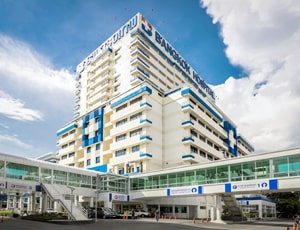
Bangkok Hospital
Bangkok, Thailand
Bangkok Hospital located in Bangkok, Thailand is accredited by JCI. Also listed below are some of the most prominent infrastructural details:
- It is recognised for the application of the newest healthcare technology.
- Blood analysis center that is not just the best in Thailand but in Asia Pacific as well.
- Biomolecule center that is the seed of healthcare equipment for Thailand and overseas.
- International affiliations and collaborations with universities and hospitals in Japan and the United States of America.
- 11 hospitals are recognised as Centers of Excellence.
- Known excellence in Trauma, Orthopedics, Cardiovascular, Neurology as well as Cancer Care.
- There is a proper streamlined patient services process followed in Bangkok Dusit Medical Services, Bangkok, Thailand.
- A well developed research center showcases the intent of the organisation to provide research based treatment opportunities to the patients.
- The group has several Medical industry partnerships as well to ensure healthcare solutions.
Our Services to better your experience
Opinion & Option
We submit the most accurate opinion and options from one or more countries for your review
Consult Privately
Consult with a certified specialist privately on our telemedicine platform even before you decide to travel
Logistics
We handle flights, visas, transfers, and accommodation—so you can focus on your health.
Recovery
Our In-house rehabilitation service packages to better your recovery and treatment outcome
Why Choose Thailand for Acute Lymphoblastic Leukemia Treatment?
The following are the growing reasons for Thailand being frequented for Pancreatic Neuroendocrine Tumor treatment:
- World-Class Health Services at Affordable Costs: The nation is proficient in advanced medical technologies and treatments, including high-quality care at often dissimilar cost ratios of Western countries.
- Qualified Professionals: Patients will find internationally trained, renowned hepatologists, surgeons, and specialists. Medical and individualised treatment options will complement the value of the care provided by the best experts in Thailand.
- Complete Medical Services: From advanced diagnostic tools such as elastography and imaging to liver transplants, Thailand has gone the extra mile to provide patients with cutting-edge facilities for total Acute lymphoblastic leukaemia (ALL) treatment.
- Medical Travel: Thailand is becoming a central international hub for medical tourism. Many accredited hospitals provide excellent service to international patients, including easy accessibility, visa assistance, and organised packages.
- Holistic Treatment: Most hospitals in Thailand work towards a mainstream plus traditional treatment regime for complete liver health recovery and wellness, thus attending to emotional and physical wellness.
Frequently Asked Questions
Survival rates are likely to vary according to the age and subtype of the disease at diagnosis and the response to treatment. Children diagnosed with ALL have no 5-year survival rates of about 85% to 90%. Adults have lower rates, but this figure is improving with treatment.
Yes, relapse is likely, especially for high-risk cases. Management of relapse may include aggressive chemotherapy, stem cell transplant, or CAR-T cell therapy.
Cancer treatment can be accompanied by side effects, which could include fatigue alongside nausea due to the shedding of hair, further summing it all into the incidence of infections and, sometimes, anaemia. These could be followed by adverse consequences wherein development could have taken place before birth, for instance, those possible with children or perhaps concerns with fertility among adults.
Stem cell transplants (either autologous or allogeneic) are for high-risk or relapsed ALL patients, as they restore healthy blood cells after the patient undergoes intensive therapy through chemotherapy or radiation.
Most cases are not hereditary; however, some genetic conditions such as Down syndrome or Li-Fraumeni syndrome may add to the likelihood of developing ALL. A family history of leukaemia may increase the risk in moderate amounts.
Of course, the top hospitals now have the next-generation sequencing capacity and genetic profiling for making personal treatment profiles according to the genetic characterisation of your leukemia type.
Medical tourism services in Thai hospitals include visa assistance, multilingual care, and international patient departments for assistance by travellers.
Depending on the treatment protocol, the primary stay can range between 2 to 8 weeks. Some treatments may require the patient to have extended follow-up visits or outpatient care.

Reviewer

Dr. Mohit Agarwal
Medical Oncologist
14 Years of Experience
One of the finest Oncologist in New Delhi, India, Dr. Mohit Agarwal has worked with several world class multidisciplinary hospitals over the years. Dr. Mohit Agarwal has over 14+ years of experience in his field. The doctor treats and manages a wide range of conditions such as Stomach Cancer, Rectal Cancer, Breast Cancer, Brain Cancer View More
Last Reviewed - January 2026