Poland Syndrome Treatment in India
- Top Accredited Hospitals
- Global Medical Standards
- Cutting-Edge Technology
- Proven Treatment Options
- High Success Rate
- Trusted by Millions

What is Poland Syndrome?
Poland syndrome is a congenital condition marked by small webbed fingers on one side of the body and an undeveloped chest muscle. On the same side of the body, there could also be anomalies of the breasts and nipples, short ribs, and reduced fat. The right side is usually affected. The majority of those impacted move and behave normally.
What can I expect if my child has Poland Syndrome?
You must watch for symptoms of Poland syndrome in children and teenagers, such as undeveloped or absent shoulder and chest muscles. unusual ribs that can occasionally cause respiratory issues. anomalies of the breast or nipple. However, individuals affected by Poland syndrome have a normal life expectancy and intelligence is within the normal range.
What are the Common Symptoms of Poland Syndrome?
Poland Syndromes symptoms are
- Underdeveloped or absent shoulder and chest muscles
- Unusual ribs that can occasionally cause respiratory issues
- Anomalies of the breast or nipple
- Unusual underarm hair placement or absence
- Deformities of the hands, including fused or short fingers
- Shortened bones of the forearm.
Causes, Risk Factors and Complications of Poland Syndrome.
CausesPoland syndrome has no recognized etiology. According to research, it might be the consequence of a disturbance in blood flow that occurs during prenatal development. The blood vessels that will develop into the subclavian and vertebral arteries on either side of the body are impacted by this disturbance, which is believed to happen around the sixth week of embryonic development. Normally, the arteries provide blood to the developing tissues that give rise to the hand and chest wall on either side. The variety of Poland syndrome signs and symptoms could be explained by differences in the location and severity of the disturbance. This condition may also entail abnormalities of the apical ectodermal ridge, an embryonic structure that aids in directing the development of the early limbs.
Although no linked genes have been found, rare occurrences of Poland syndrome are believed to be brought on by a genetic alteration that can run in families.
Risk Factors
The spine may become fused or deformed in severe Poland syndrome instances. Respiratory difficulties and thoracic deformations may result from this. People with Poland syndrome may have specific bone abnormalities. This includes the cartilage and ribs where they join to the sternum, which may be missing or underdeveloped.
ComplicationsIn order to assist avoid impairment, Poland syndrome must be treated. A patient's ability to move on one side of the body may become considerably impaired over time. For instance, they may have trouble reaching for or picking up objects. Range of motion may also be restricted by Poland syndrome.
Sprengel’s deformity is a disorder that can occasionally arise. This results in a raised shoulder blade that generates a bump at the base of your neck.
Poland syndrome can occasionally result in issues with the health of the spine. Kidney issues could potentially result from it. In extreme situations, the heart may become misaligned on the right side of your chest.
Because Poland syndrome is frequently identified in teenagers who are already adjusting to other changes, it can have a negative psychological impact.
Connect with our advisor for a PRIORITY response
Latest Research and Technologies in the Treatment of Poland Syndrome in India.
Currently, Poland Syndrome treatment in India is focusing on pectoral muscle reconstruction. To enhance the appearance of the chest in cases of significant muscle underdevelopment, cosmetic and reconstructive surgeons may conduct muscle reconstruction.
Hand and Finger Surgery: Depending on the particular hand and finger abnormalities present, different surgical techniques can be used.
Poland Syndrome Prevention Tips
Since the exact cause of Poland Syndrome is unknown and the majority of cases are thought to be not inherited, there are currently no known preventative measures for this congenital condition, which occurs during fetal development. Nevertheless, early detection and management can greatly improve the quality of life for those who are affected.
Treatment options for Poland Syndrome
Breast Reconstruction: Both men and women with Poland's Syndrome frequently seek reconstructive surgery to address these anomalies in the appearance of the breast and chest. Teenage girls who have atypical or noticeably asymmetrical breast development often feel self-conscious and may even suffer from severe anxiety. Numerous considerations, such as the patient's age and the severity of their ailment, will determine the sort of surgery and when such reconstructive surgery is performed.
Cost Start From USD 4000 - USD 7000Explore Options
These breast and chest deformities have been corrected using a variety of ways. Historically, the most prevalent treatments for females with Poland's Syndrome have been tissue expanders, implants with or without latissimus dorsi muscle flaps, and TRAM muscle flaps. Traditionally, l latissimus dorsi muscle flaps and specially made implants have been used to treat men. Although implant reconstruction is frequently recommended as a first step, it can be particularly difficult to get a good result with these treatments because of the lack of skin, breast tissue, and occasionally muscle available to cover an implant.
The severity of the symptoms determines when Poland syndrome is diagnosed. You might not experience any symptoms until puberty, despite the fact that the disease is present from birth. At birth, severe cases are typically more noticeable. It's possible to observe underdeveloped fingers first.
Your doctor will check for Poland syndrome symptoms during a physical examination. Additionally, they will inquire as to when you become aware of the symptoms.
A physical examination and imaging tests, including CT, MRI, and X-rays, are used to diagnose Poland syndrome. MRIs and CT scans are particularly useful in identifying the damaged muscle groups for your doctor. On the other hand, X-rays give an interior view of the afflicted bones. X-rays are very beneficial for your:
- Hands
- Ribs
- Shoulder blades
- Forearms
Although not everyone with Poland Syndrome needs rehabilitation, physical therapy in particular can be an important component of treatment when the condition results in noticeable deformities or functional limitations. This is especially true after reconstructive surgery to aid in muscle recovery and adaptation to the changes made during the procedure; the degree of rehabilitation required will depend on how severe the condition is.
Currently, no medication is available for treatment of Poland Syndrome and only option is Breast Reconstructive surgery.
Instantly Connect with our Specialists


Hospitals for Poland Syndrome in India

Yashoda Hospital, Malakpet
Hyderabad, India
Yashoda Hospital, Malakpet located in Hyderabad, India is accredited by NABH, NABL. Also listed below are some of the most prominent infrastructural details:
- Multi-bed facility
- High-tech labs, modular operation theaters
- Advanced medical equipement
- Dedicated rooms for patients with all facilities
- State-of-art technology
- 24/7 blood bank
- State of the art Cardio-Thoracic Center with the latest CATH LAB Equipment & Modular steel operation theatre
- Neurosurgery department equipped with an operating microscope, high-speed drill & stereotaxy
- 24-hour Emergency services to take care of all kinds of trauma and other orthopedic emergencies
- Pulmonology department equipped with modern gadgets.
- One of the best PFT labs and bronchoscopy units
- Nephrology services include Renal Biopsy, AV Fistulas, AV Grafts & Permanent Catheter Insertions, Hemodialysis; Temporary Access For Dialysis; Peritoneal Dialysis
- Has a comprehensive cancer care unit following a trans-disciplinary & multi-modality approach
- State-of-the-art services of Digital X rays, Flouroscopy, Ultrasonography, OPG, Mammography, CT 64 Slices, MRI, etc.
- Airport Transfer Service
- Scheduling Of All Medical Appointment
- Processing Of Medical Second Opinion
- Provide Language Interpreter
- Special Dietary Needs / Religious Arrangement
- Coordination Of Admissions Process
- Cost Estimates For Anticipated Treatments
- Foreign Exchange service
- Billing and Finance Related Service
- Providing Information Of Patient’s Relatives Back Home
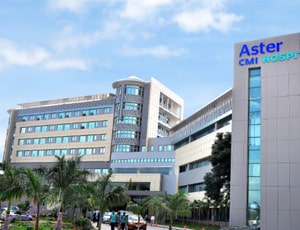
Aster CMI Hospital
Bangalore, India
Aster CMI Hospital located in Bengaluru, India is accredited by JCI, NABH. Also listed below are some of the most prominent infrastructural details:
- Around 500 bed capacity
- Primary care to Quaternary care services
- Outpatient and inpatient departments
- Day care center for small children
- Availability of Surgical suites
- Intensive Care Units
- 24-hour Emergency and Trauma Care
- Emergency Unit especially for children
- Newly launched the Lung and Heart Transplant Centre
- Video Consultation with doctors available on GraphMyHealth
- A specialised Aster Center of Excellence for Women & Children
- Latest Minimally Invasive Procedures being performed
- Safe Interventional Procedures
- Control of Infection protocols are strictly followed
- Aster Holistic Collaborative Care: Aster Palliative Care for lowering suffering if critically ill patients, Physical Medicine & Rehabilitation, Aster Wellness, Psychology, Chronic Pain Management, Nutrition & Dietetic, Podiatry Care etc.
- 11 Centers of Excellence
- An academics focus with BSc Program, MEM Program, Pediatric Fellowship Program
- A streamlined International patient care center with dedicated services and technology enabled processes

Max Super Specialty Hospital, Vaishali
Ghaziabad, India
- Max Super Speciality Hospital, Vaishali, Ghaziabad, is a leading multi-speciality hospital with 387+ beds and 37+ clinical specialities, offering advanced care in Cardiology, Neuro Sciences, Oncology, Orthopaedics, Transplants, Gastroenterology, and Reconstructive Surgery.
- Supported by 389+ doctors and 1038+ trained staff, the hospital combines state-of-the-art technology, including robotic surgery and advanced imaging systems, with compassionate, patient-centred care.
- Accredited by NABH and NABL, Max Vaishali is a trusted destination for both domestic and international patients seeking high-quality, integrated medical services.
Our Services to better your experience
Opinion & Option
We submit the most accurate opinion and options from one or more countries for your review
Consult Privately
Consult with a certified specialist privately on our telemedicine platform even before you decide to travel
Logistics
We handle flights, visas, transfers, and accommodation—so you can focus on your health.
Recovery
Our In-house rehabilitation service packages to better your recovery and treatment outcome
Why Choose India for Poland Syndrome Treatment?
Here are some of the reasons for choosing India:
- Due to advancements in medical facilities, such as minimally invasive surgical techniques
- India has highly skilled plastic surgeons with expertise in complex reconstructive surgeries
- World-class experts include highly experienced doctors, JCI, and NABH-accredited healthcare institutions.
- Compared to other countries, treatment in Indian hospitals is cost-effective.
- Indian hospitals provide international patient services, including a multilingual support system.
- Improved treatment methods and biological therapies.
Frequently Asked Questions
Yes, the route of treatment is usually determined by the severity of Poland syndrome and may include surgery to make the hand the most functional or injections or implants to augment the underdeveloped chest region.
With skilled plastic surgeons and cutting-edge medical technology, India has demonstrated significant success rates in treating Poland Syndromes. The nation's healthcare institutions offer top-notch treatment alternatives, guaranteeing successful outcomes for many patients.
Yes, many Indian hospitals offer the following for Poland Syndromes treatment:
- Advanced diagnostic tools like MRI, CT scan, electromyography, and PET scan for accurate neurofibroma diagnosis.
- Skilled neurologist, oncologist and surgeons for Poland Syndromes.
- Advanced radiation therapy and chemotherapy procedures.
- Comprehensive post-surgery care and rehabilitation for long-term health benefit.
Always consider the following factors when selecting Indian hospitals:
- Hospitals that are accredited (authorised by JCI and NABH).
- Patient reviews and success rates.
- Hospitals that provide seamless care to patients from abroad.
In general, Poland Syndrome treatment has much improved in India. Though the exact success rate can vary depending on the severity of the condition and the surgical technique used, more severe cases may have slightly lower success rates. In India, the success rate of treating Poland Syndrome is generally thought to be high for cosmetic improvement, with the majority of patients experiencing significant aesthetic improvement after breast reconstructive surgery, especially when treated by experienced plastic surgeons.
A noticeable asymmetry in the chest, underdeveloped or absent chest muscles on one side, abnormalities in the breast or nipple on the affected side, and possible hand abnormalities like short or fused fingers—all of which typically occur on the same side of the body—are indicators that your child may have Poland Syndrome.
Poland syndrome is believed to be caused by a transient change in blood flow in the growing upper limb and shoulder girdle during week seven of pregnancy. The life expectancy and IQ of people with Poland syndrome are both within the normal range.
Your healthcare practitioner will assist you in selecting the best course of treatment for your child if your child has Poland Syndrome. Keep an eye on their physical growth, deal with any issues related to their body image at an early age, offer them emotional support.

Reviewer

Dr. Pradeep Jain
General & Laparoscopic Surgeon
33 Years of Experience
Dr. Pradeep Jain has completed his MBBS, MS - General Surgery, MCh - Surgical Gastroenterology/G.I. Surgery, and MCh - Surgical Oncology. He is a GastroIntestinal Surgeon, General Surgeon, Surgical Oncologist, Bariatric Surgeon par excellence with total experience of 36 years of which about 33+ years have been as a specialist View More
Last Reviewed - January 2026