Macular Hole Treatment in India
- Top Accredited Hospitals
- Global Medical Standards
- Cutting-Edge Technology
- Proven Treatment Options
- High Success Rate
- Trusted by Millions

What is a macular hole?
A macular hole is a break or hole in the eye tissue, or a full-thickness defect is in the central part of the retina. A macular hole can impair central vision, which is vital for tasks like reading, driving, and recognising faces.
What is the Importance of Timely Treatment?
Timely treatment matters because, if left untreated, the hole is less likely to fully heal and restore vision. Early diagnosis prevents further damage to central vision and improves the chances of a better visual outcome.
What are the common symptoms of a Macular Hole?
- Blurred vision
- Distorted vision
- Straight lines might look bent or curvy
- Difficult to read small print
- A dark or blind spot in the centre of your sight.
- Decreased clarity of vision
Causes and Risk Factors of a Macular Hole
Causes
- Vitreous shrinking: as you age, the vitreous gel inside the eye may shrink, causing the macula to tear.
- Trauma: any direct injury may lead to the formation of the macular hole
- Disease condition: some disease conditions, like diabetic retinopathy, can cause damage to the macula and retina
- Myopia: a persistent high degree of myopia (nearsightedness) may make a person susceptible to a macula hole
- Macula pucker: a scar tissue membrane on the macula may cause a hole.
Risk Factors
- Older age
- High myopia (severe short-sightedness).
- Previous eye surgery, related to retinal or cataract procedures.
- Any eye injury or eye trauma.
- Some retinal conditions that affect the macula.
Latest Research and Technologies in the Treatment of Macular Hole in India
Recent research technologies include minimally invasive vitrectomy, improved OCT-guided diagnosis, and newer internal limiting membrane (ILM) flap techniques. Researchers are also working on intraoperative OCT and newer techniques for recurrent macula hole. Indian eye centers are also involved in research on newer surgical approaches and retinal technologies. These techniques are still evolving, and the best treatment depends on the retina's condition, the size, duration, and type of macular hole.
Treatment options for Macular Hole
Vitrectomy: it is also known as macular hole surgery. During the procedure, the surgeon removes the vitreous gel pushing on the macula and replaces it with an air bubble or gas. This bubble acts as a temporary "band-aid," holding the edges of the macular hole together while it heals. The patient may need to keep their head in a specific position, usually lying on their back, for several days or weeks after the procedure to help the bubble flatten the hole.
- Clinical assessment:
- Medical examination: The doctor may ask for a detailed medical history and an overview of the signs and symptoms the patient has experienced.
- Slit lamp examination: a common eye test to check the eyes' overall health
- Dilated fundus examination: the pupil is dilated to examine the retina and macula using specialized instruments to look for a macular hole and other retinal changes.
- Imaging Tests:
- Optical Coherence Tomography (OCT): the gold standard test for the diagnosis of macular hole. The main imaging test for diagnosing a macular hole. It provides a detailed cross-sectional image of the retina and helps determine the size, stage, and extent of the hole.
- OCT angiography (OCTA): May be used in some selected cases to assess the retinal blood vessels around the macula, particularly when other retinal abnormalities are suspected.
- No medication can directly repair a macular hole. Some supportive medicines, such as antibiotic or anti-inflammatory eye drops, may sometimes be prescribed after the treatment to prevent infection and control inflammation. These medications do not treat the hole but support recovery.
Instantly Connect with our Specialists


Hospitals for Macular Hole in India

Indraprastha Apollo Hospital
Delhi, India
Indraprastha Apollo Hospital is known for delivering treatment to over 200,000 patients every year; 10,000 of which are generally medical tourists. The efficient team of doctors has the record of 99.6 percent success rate. Indraprastha Apollo Hospital deals in treatment of over 50 specialities.
Let’s see some of the features of the infrastructure:
- Spread over 15 acres, the hospital has 710 beds.
- 6 beds dedicated to bone marrow transplant units with very strict infection control practices.
- 64-Slice Scan coupled with data acquisition which provides highest temporal resolution
- One of the hospitals to be using Da Vinci Robotics Surgery System
- In South Asia, the Spect-CT and Pet-CT got their first installation at Indraprastha Apollo Hospital in India
- Technologies such as PET- MR, BrainLab Navigation System, PET-CT, Portable CT Scanner, Tilting MRI, NovalisTx, Cobalt based HDR Brachytherapy, Hyperbaric Chamber, DSA Lab, Fibroscan, 3 Tesla MRI, Endosonography, 128 Slice CT scanner are all installed at the hospital.
- The Cancer Institute at Indraprastha Apollo is equipped with a highly advanced Radiation Oncology Center with ClinaciX, NovalisTx, and HDR-Brachytherapy.
- It is equipped with the largest Sleep Lab in Asia, & has one of the largest Dialysis Units in India.
- A large number of ICU beds than any other Private Hospitals in India.
- WIFI is accessible across the whole campus.

nM Virani Wockhardt
Rajkot, India
A leading multispecialty hospital in Rajkot, Wockhardt Hospital is committed to providing top-notch medical care and modern treatments. With a 95% satisfaction rating, Wockhardt has successfully treated 200,000 emergency cases and more than 1.4 million OPD patients. The hospital's dedication to providing high-quality care and safety is demonstrated by its NABH and NABL accreditation. Wockhardt guarantees easily accessible, high-quality healthcare by providing a surgery 0% interest-free EMI option and a fully furnished 'ICU on Wheels' that is open 24/7. Wockhardt Hospital is a reliable option for patients looking for advanced medical care in Rajkot and beyond because of its staff of skilled specialists and outstanding reputation for excellence.
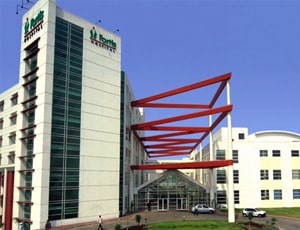
Fortis Hospital
Noida, India
Fortis Healthcare Limited is one of India’s prominent providers of integrated healthcare services, offering comprehensive medical care across multiple specialities. The company’s operations span hospitals, diagnostic centres, and day-care speciality facilities, ensuring a wide range of healthcare solutions under one umbrella. Fortis has established a strong presence across the country, managing 33 healthcare facilities, which include joint ventures and operational & management (O&M) setups, across 11 states.
The company’s hospital network comprises more than 5,700 operational beds, including O&M beds, catering to patients with varied healthcare needs. In addition to inpatient services, Fortis operates around 400 diagnostic laboratories, providing reliable and timely diagnostic support for accurate medical care. This extensive network enables Fortis to deliver high-quality healthcare services consistently and efficiently, from routine diagnostics to specialised treatments and complex procedures.
Our Services to better your experience
Opinion & Option
We submit the most accurate opinion and options from one or more countries for your review
Consult Privately
Consult with a certified specialist privately on our telemedicine platform even before you decide to travel
Logistics
We handle flights, visas, transfers, and accommodation—so you can focus on your health.
Recovery
Our In-house rehabilitation service packages to better your recovery and treatment outcome
Why Choose India for Macular Hole Treatment?
- Accredited hospital: India has advanced, highly specialized hospitals backed by top-tier JCI- and NABH-accredited eye hospitals that use advanced optical coherence tomography (OCT) and high-success surgical techniques.
- Specialised surgeons: Indian vitreoretinal surgeons routinely handle complex cases using international protocols.
- Modern diagnostic procedures: Patients may have access to advanced ophthalmic procedures like micro-incision vitrectomy surgery (MIVS), and specialised centres offer internal limiting membrane (ILM) peeling or flap techniques to support diagnosis and treatment planning.