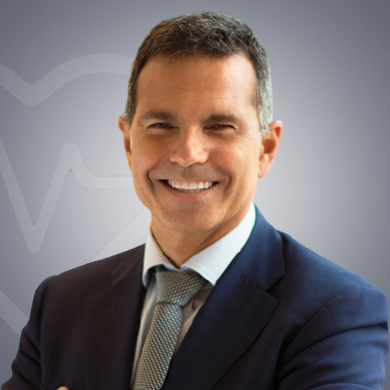
Cardiac enterologist
Centro Medico Teknon , Barcelona, Spain
30 Years of experience
Speaks: Spanish , English
Dr. Xavier Ruyra Baliarda is a specialized Cardiac Surgeon in Spain. And one of the most sought after medical specialists in Barcelona, Spain. The doctor has over 30 Years of experience and is associated with Centro Medico Teknon.
Association and Memberships Dr. Xavier Ruyra Baliarda is part of:
- Member of the Spanish Society of Cardiac Surgery.
- Member of the European Board of Cardio-Thoracic Surgery and the European Society of Cardio-Thoracic Surgery.
- Spokesperson of the Catalan Organisation of Transplantation (OCATT).
- Associate Professor of Surgery at Autonomous University of Barcelona.
Certifications :
- European Board of Thoracic and Cardiovascular Surgery (European Council of Thoracic and Cardiovascular Surgery (2001).
- Training in Cardiovascular Thoracoscopy Advanced Level. Minimally Invasive Center, ?ceres (1997).
- Educational Course on Total Arterial Myocardial Revascularization, Instituto di Clinica Cardiovasculare, Chieti (Italy) (1997).
- Cours superieur de Technique Chirurgicale (Advanced Course in Surgical Technique), University of Paris, Hopital Broussais (1997).
Qualifications :
- Bachelor of Medicine and Surgery with an Excellent rating from the University of Barcelona (1989).
- Cardiovascular Surgery Specialist from the University of Barcelona (1995).
Hospital Address :
Centro M
Medical Expertise of Dr. Xavier Ruyra Baliarda
- Dr. Xavier Ruyra Baliarda is an eminence of Cardiac thoracic & vascular surgery.
- He specialises in minimally invasive cardiac surgery, as well as mitral regurgitation, aortic root surgery, MVR, bloodless surgery, and TAVI catheter valve implantation, among others.
- Forbes listed him one of the top five cardiovascular surgeons in Spain. Dr. Xavier is a pioneer in the use of virtual reality (Ross procedure) to implant an artificial aortic valve.
- Dr. Ruyra has discovered a variety of surgical techniques. Dr. Xavier Ruyra has done over 5000 cardiac operations with his team.
- In addition, he has merged his healthcare job with teaching, as a professor in specialist courses, and research, as the author of scientific articles
- He is president of the CardioDreams Foundation, an association that performs free surgeries for people without resources.
- He is a member of the Catalan Transplantation Organization, the Spanish Society of Cardiac Surgery, the European Board of Cardio-Thoracic Surgery, and the European Society of Cardio-Thoracic Surgery, etc.
- He has participated in 60+ presentations at conferences.
- Dr. Xavier communicates fluently in Catalan, Spanish, French, and English
How it Works
- Choose the doctor/doctor type
- Book a Slot based on availability
- Fill in your personal details (Name, Phone Number, Symptoms)
- Make online payment via payment gateway
- Our patient care team will assist you in getting in touch with the doctor in the meeting room
What do we recommend?
Please make sure to see your doctor using Telemedicine before you even board a flight