Fuchs' Endothelial Dystrophy Treatment in Thailand
- Top Accredited Hospitals
- Global Medical Standards
- Cutting-Edge Technology
- Proven Treatment Options
- High Success Rate
- Trusted by Millions

What is Fuchs' endothelial dystrophy?
Fuchs endothelial dystrophy is a condition that causes vision problems. It is a type of posterior corneal dystrophy that affects the innermost layer of corneal endothelial cells and Descemet’s membrane (the basement membrane). It causes loss of corneal endothelial cells, leading to fluid buildup (oedema) and small bumps called guttata that reduce visual clarity.
What is the Importance of Timely Treatment?
Regular eye exams help monitor FECD progression and determine when treatment is needed. Early disease may require observation and symptom management rather than surgery. When corneal swelling affects vision or causes persistent discomfort, an ophthalmologist may recommend additional treatment, including endothelial keratoplasty when appropriate.
What are the common symptoms of Fuchs' endothelial dystrophy?
Symptoms and their intensity can vary. The following describes the symptoms associated with the disease.
- Reduced corneal clarity
- Eye movement-induced pain
- Impaired vision at night or in low light
- Reduced visual acuity (decreased central vision)
- Cloudiness
- Redness and swelling
- Eye discomfort or a gritty sensation
- Glare or sensitivity to light
- Blurred vision
Causes and Risk Factors of Fuchs' Endothelial Dystrophy
Causes
- Genetic factors: FECD has a genetic component. Expanded repeats in the TCF4 gene are strongly associated with many adult-onset cases.
- Other genetic variants: Variants in genes are associated with some early-onset forms of the disease.
- Progressive endothelial cell dysfunction: The gradual loss of endothelial cell function reduces the cornea's ability to regulate fluid and maintain transparency.
Risk Factors
- Age: The earliest signs of Fuchs’ dystrophy may be visible in people in their 30s and 40s. But the disease usually affects vision after age 50.
- Sex: Research shows evidence that females are at higher risk than males.
- Family history: It is more common in people with a biological family history, which increases risk.
- Smoking: It increases oxidative stress, which can damage corneal endothelial cells.
- Previous eye surgery: Procedures like cataract surgery can put extra strain on corneal cells, especially in people who are already at risk.
- UV exposure: Long-term ultraviolet exposure may cause small deposits called guttae to form in the cornea.
- Hormonal: Hormonal factors may also influence FED progression, as the condition is more prevalent in postmenopausal women, which is linked to estrogen deficiency
Latest Research and Technologies in the Treatment of Fuchs' Endothelial Dystrophy in Thailand
- Newer approaches, including DWEK (Descemetorhexis without endothelial keratoplasty) combined with ROCK inhibitors and improved DMEK (Descemet Membrane Endothelial Keratoplasty) techniques, are being studied to support corneal healing and improve surgical outcomes. Studies support continued evaluation of surgical outcomes, graft survival, and complications, but individual-centre findings should not be interpreted as national results. Gene-based and regenerative treatments remain areas of investigation rather than established routine treatments for FECD.
Treatment options for Fuchs' Endothelial Dystrophy
Inner corneal transplant: Descemet membrane endothelial keratoplasty, or DMEK, is a surgical procedure in which the back layer of the cornea is replaced with healthy endothelial cells from a donor.
Cornea transplant: If you previously had eye surgery, an eye care professional may suggest a partial-thickness cornea transplant, known as Descemet-stripping endothelial keratoplasty, or DSEK. In rare cases, you may need a complete cornea transplant, known as penetrating keratoplasty (PK).
Cost Start From 5500Explore Options
- Clinical assessment:
- Eye examination: Clinical assessment involves a comprehensive eye examination and a detailed clinical evaluation of the condition, followed by a medical history and physical examination
- Slit-lamp examination: Performed to look for changes in the corneal structure, particularly bumps called guttata and corneal swelling. The doctor also checks visual acuity to see how the condition affects vision.
- Imaging Tests:
- Specular microscopy: Examines the endothelial cells and assesses their number, size, and shape.
- Pachymetry: It measures the corneal thickness to track fluid accumulation
- Optical tomography: A noninvasive imaging method that uses images of the back of your eye using reflected light.
- Medicines for Fuchs' endothelial dystrophy mainly relieve symptoms rather than reverse endothelial cell loss. Hypertonic saline drops or ointment may reduce corneal swelling, while artificial tears relieve irritation. Painful corneal blisters may require specialist treatment. ROCK inhibitors may support endothelial cell migration in selected cases, depending on clinical suitability and availability.
Instantly Connect with our Specialists


Hospitals for Fuchs' Endothelial Dystrophy in Thailand
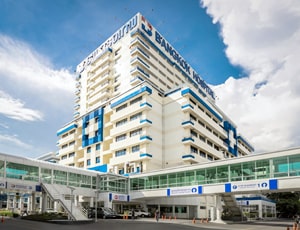
Bangkok Hospital
Bangkok, Thailand
Bangkok Hospital located in Bangkok, Thailand is accredited by JCI. Also listed below are some of the most prominent infrastructural details:
- It is recognised for the application of the newest healthcare technology.
- Blood analysis center that is not just the best in Thailand but in Asia Pacific as well.
- Biomolecule center that is the seed of healthcare equipment for Thailand and overseas.
- International affiliations and collaborations with universities and hospitals in Japan and the United States of America.
- 11 hospitals are recognised as Centers of Excellence.
- Known excellence in Trauma, Orthopedics, Cardiovascular, Neurology as well as Cancer Care.
- There is a proper streamlined patient services process followed in Bangkok Dusit Medical Services, Bangkok, Thailand.
- A well developed research center showcases the intent of the organisation to provide research based treatment opportunities to the patients.
- The group has several Medical industry partnerships as well to ensure healthcare solutions.

Bangpakok 9 International Hospital
Bangkok, Thailand
Bangpakok 9 International Hospital located in Bangkok, Thailand is accredited by JCI. Also listed below are some of the most prominent infrastructural details:
- It would be prudent to summarise the Medical Services provided at the Bangpakok 9 International Hospital (BPK 9), Bangkok, Thailand:
- Cosmetic Dentistry
- Dental Implants
- Electrocardiogram (EKG or ECG)
- Exercise Stress Test
- Health Screening
- Laser Vagina Firming
- Pediatric Physical Therapy
- Perfect Slim by Vela II
- Physical Therapy for Musculoskeletal
- Prosthodontics
- The Medical Services are also inclusive of the International Patient Services such as the ones listed here:
- Thai, English, French, Arabic, Chinese, Myanmar, Cambodia, Bangladeshi, Bahasa and Tagalog are the languages in which there are Translation services available for International Patients.
- Visa extension related assistance
- International health insurance related assistance
- Embassy and international organizations related assistance
- A variety of meals of choice for International Patients
- Email consultation services
- Transfer to either airport and/or hotels
- Prayer room
- Four different types of rooms are available such as Deluxe room, two kinds of suites, and a VIP suite.
- Hospital facilities like The Coffee shop, Food Hall, Cafe and Medical Spa.
- Complete health and safety protocols are maintained in the various Medical Centers some of whom are as follows:
- Aesthetic Center
- 24 Hour Emergency Center
- Allergy Center
- Breast Center
- bSmart Center
- Checkup Center
- Dental Center,
- Happy Long Life Center
- Medical Fitness Center
- Psychiatric Center
- Rehabilitation Center
- Sleep Disorders Center
Our Services to better your experience
Opinion & Option
We submit the most accurate opinion and options from one or more countries for your review
Consult Privately
Consult with a certified specialist privately on our telemedicine platform even before you decide to travel
Logistics
We handle flights, visas, transfers, and accommodation—so you can focus on your health.
Recovery
Our In-house rehabilitation service packages to better your recovery and treatment outcome
Why Choose Thailand for Fuchs' Endothelial Dystrophy Treatment?
- Specialised corneal surgeons: Major eye centres have highly experienced corneal and endothelial disorder specialists, as well as world-renowned, dedicated eye centres.
- Diagnostic Facilities: Confirm access to appropriate examinations and tests, such as slit-lamp examination, specular microscopy, pachymetry, and corneal imaging when indicated.
- Surgical Options: Some centres may offer DMEK, DSAEK, or other corneal procedures. Confirm that the proposed procedure is available and appropriate for the patient's condition.
- Individualised Treatment Planning: Treatment should reflect disease severity, visual needs, endothelial function, and other eye conditions rather than relying on a standard approach for every patient.
- International Patient Support: Some hospitals may assist with appointments, medical records, interpretation, and travel arrangements. Confirm available services and the postoperative monitoring plan before travelling.
Frequently Asked Questions

Reviewer
Dr. Vidit Tripathi
ENT Surgeon
24 Years of Experience
One of the finest ENT Surgeon in New Delhi, India, Dr. Vidit Tripathi, has worked with several world class multidisciplinary hospitals over the years. Dr. Vidit Tripathi has over 24+ years of experience in his field. The specialist treats and manages a wide range of conditions such as Goiter, Radiation Necrosis in Neck, Neck Injury, Perforates Eardrum View More
Last Reviewed - January 2026